
ITEM# UJKA505 – Catalogue 46 – Sold
A Chû-Aoe Katana (青江)
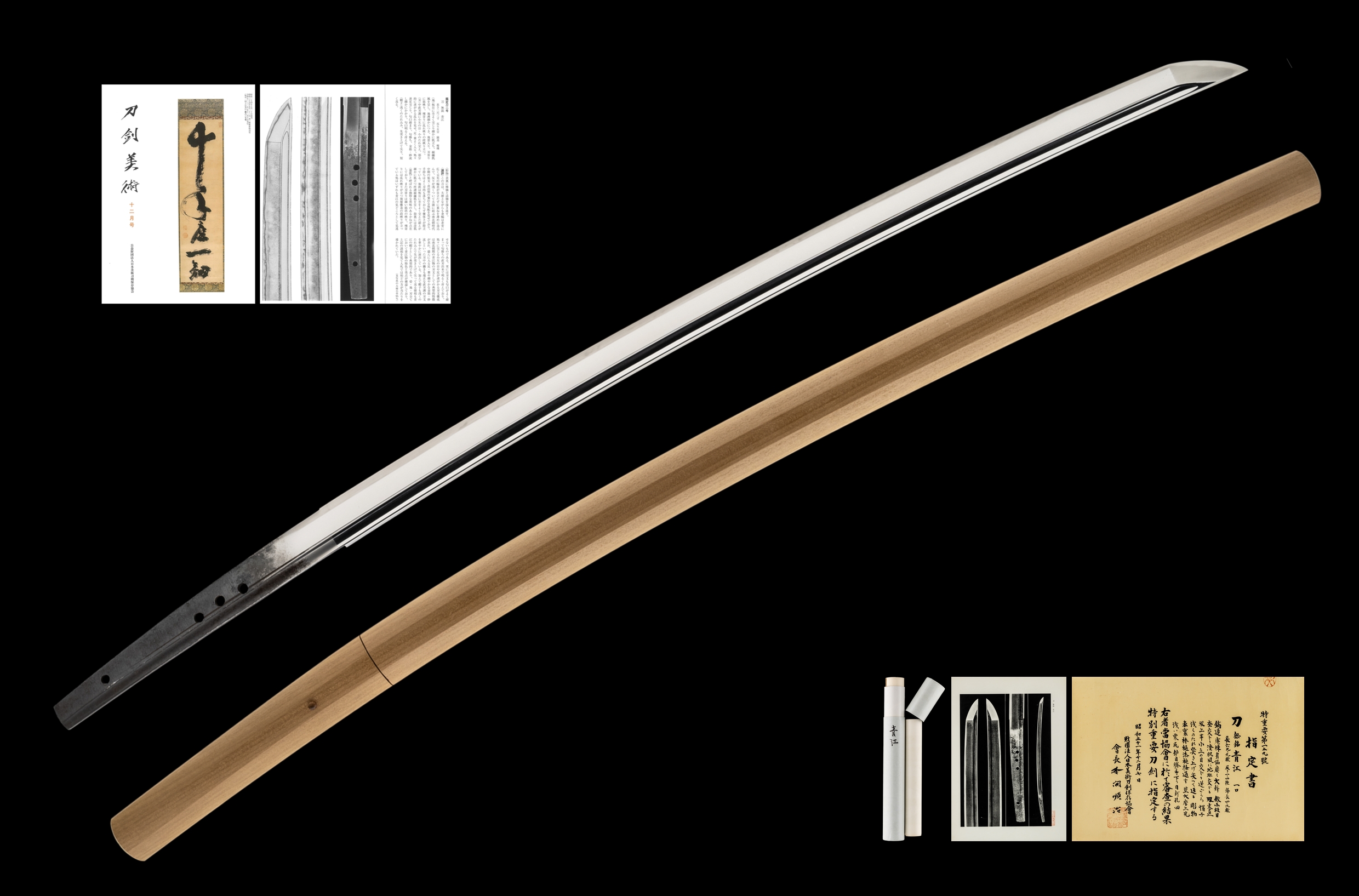
The Aoe (青江) school, meaning “Blue River,” rose to prominence in Bitchû Province during the late Heian period and reached its absolute peak during the Nanbokuchô era. Working near the Takahashi River with access to exceptional iron ore, the smiths of Aoe were both warriors and craftsmen – their dual identity as fighters and forgers gave their blades a directness and authority that set them apart from the more courtly schools of Yamashiro. The school’s fortunes were bound to the Southern Court, and when those patrons fell at the century’s end, Aoe production vanished almost overnight. The blades they left behind – particularly those forged during the golden Enbun and Jôji eras – are now among the most coveted swords in Japanese history.
This katana is the definitive 14th-century Nanbokuchô Aoe blade. It passed Jûyô Tôken in July 1976 and was elevated to Tokubetsu Jûyô Tôken just five months later at only the 5th TJ session in December that year. In November 2025 the NBTHK selected it as a study sword for their monthly kantei session, where only five swords are chosen as exemplary teaching tools – and nearly all participants correctly identified it as Aoe. The blade was subsequently featured and documented in the December 2025 issue of Token Bijutsu (No. 827). Even the 1963 torokusho examiner couldn’t help himself, breaking protocol to write “Aoe” on the official registration card – the attribution was so self-evident that leaving it blank would have felt wrong. It belongs to an elite group of just ten ô-suriage mumei long swords attributed to the Aoe school that achieved Tokubetsu Jûyô status on merit alone, without provenance or attribution to an individual smith to bolster the case.
The blade is in remarkable health. Despite being heavily shortened (ô-suriage), it retains an exceptionally wide mihaba and a magnificent ô-kissaki – the grand, powerful sugata characteristic of Enbun-Jôji-era production. The jigane displays the school’s most celebrated hallmark: refined chirimen-hada, a crepe-silk grain of ko-itame and mokume so finely worked it resembles the surface of Japanese silk fabric. Sumihada spots appear in glorious fashion on the omote, and complex dan-utsuri – straight near the edge, irregular toward the mune – is a quintessential Aoe highlight. The hamon flows in precise chû-suguha, enlivened by ko-gunome, saka-ashi, chôji-ashi, kinsuji, and sunagashi; in the monouchi it tilts into characteristic saka-ko-gunome. The bôshi terminates in a shallow notare-komi with a sharp, thrusting togari point and a brief kaeri – textbook Aoe in every detail. Both sides carry a deep bô-hiwith a slender soe-bi running alongside into the tang. The habakiis gold-foil over a copper ground.
| Item Number | UJKA505 |
| Sword Type | Katana |
| Attribution | Chû-Aoe |
| School | Aoe (青江) |
| Province | Bitchû |
| Period | Koto – Nanbokuchô period (Enbun-Jôji eras: 1356~1368) |
| Nagasa | 69.9cm |
| Sori | 1.4cm |
| Moto-haba | 3.13cm |
| Saki-haba | 2.52cm |
| Kissaki | 4.95cm |
| Moto-kasane | 6.2mm |
| Saki-kasane | 4.7mm |
| Nakago | 22.4cm |
| Weight | 890g |
| Nakago | Ô-suriage mumei; shallow kurijiri; katte-sagari yasurime; four mekugi-ana |
| Jihada | Ko-itame mixed with mokume, chirimen-hada, fine ji-nie, chikei, sumihada, dan-utsuri |
| Hamon | Chû-suguha, ko-gunome, ko-notare, ashi, yô, saka-ashi, kinsuji, sunagashi |
| Boshi | Shallow notare-komi; pointed togari with tsukiage tip; short kaeri |
| Horimono | Bô-hi with soe-bi on both sides, running into the tang |
| Certificates | NBTHK Tokubetsu Jûyô Tôken (5th session, December 7, 1976) – Certificate No. 159 |
| Habaki | Gold-foil over copper ground |
| Catalogue | Catalogue 46 |
| Status | Sold |
| Includes | Shirasaya, fabric bags, stand, kit, printed description |