
ITEM# UJKA486 – Catalogue 45 – Sold
A Senjuin Katana (千手院)
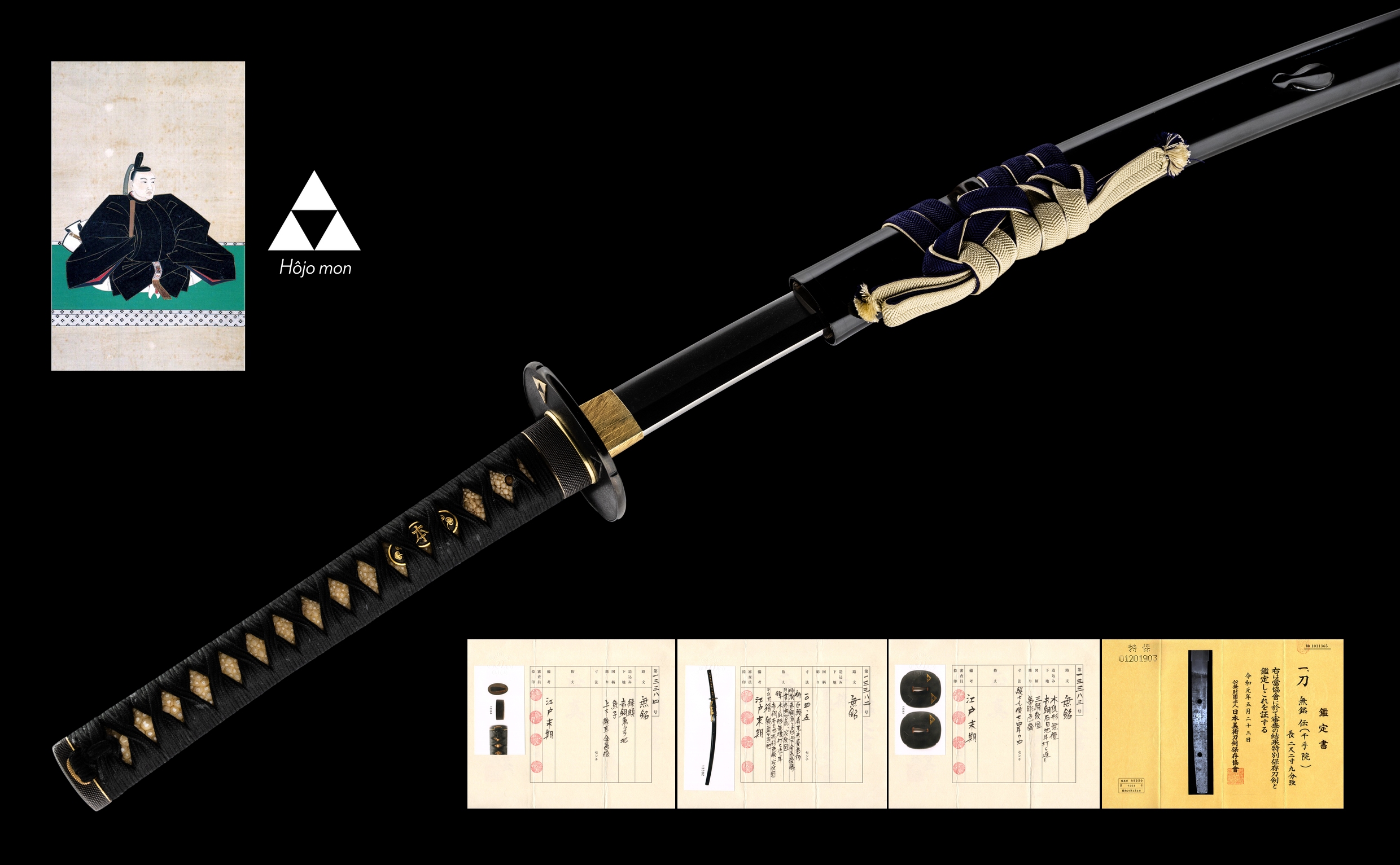
The Senjuin school holds a singular place in Japanese sword history as the earliest and most refined of the five great schools of the Yamato tradition. Its origins reach back to the late Heian period, when smiths connected with Tôdaiji temple and its warrior monks forged blades at a sub-temple in the Senju valley — the sub-temple named Senju-in after the bodhisattva Senju Kannon. The founding figure was Yukinobu (行信) in the mid-12th century, followed by Shigehiro (重弘), who served Emperor Go-Toba (後鳥羽天皇). Because their works were made so early and most later shortened, signed examples are virtually unknown — a rarity that only heightens the aura of antiquity surrounding every authentic piece. Scholars identify three phases: Ko-Senjuin of the late Heian to early Kamakura, Chû-Senjuin from mid-Kamakura to Nanbokuchô, and Sue-Senjuin into the Muromachi period. This blade belongs to the middle and finest phase.
Originally forged as a tachi — and unmistakably so in its long, sweeping tachi-sugata with deep koshi-zori and composed small kissaki — the blade has been greatly shortened (ô-suriage) and is now certified as a katana, though its soul remains that of a classical Kamakura tachi. The jigane is superb: a rich mix of itame with flowing nagare and mokume, covered in fine ji-nie and streaked throughout with lively chikei. A captivating utsuri flows parallel to the hamon, giving the blade a mysterious inner luminescence that is the hallmark of great Kotô steel. The hamon is a refined hosô-suguha bright with nie, gently varied by small ko-gunome, enriched with wisps of hotsure, streams of sunagashi, and flashes of kinsuji. The bôshi is straight with a hint of hakikake, turning back in a composed ko-maru kaeri. A masterwork of Yamato elegance and restraint.
The blade is accompanied by a marvellous mid-Edo period uchigatana-koshirae lacquered in glossy black (kuro-roiro-nuri), whose fittings tell two intertwined stories of Sengoku-era power. The tsuba — a shapely mokkô-form shakudô piece bearing the famous uroko (scale pattern) crest of the Go-Hôjô clan — recalls the century-long ascendancy of the lords of Odawara Castle and their final stand against Toyotomi Hideyoshi in 1590. The menuki carry the Tachi Aoi and Hon no ji crests of the Honda daimyô family, associated with the legendary retainer Honda Tadakatsu. Together, former adversaries now coexist on a single koshirae — a quietly eloquent emblem of the transition from the turbulence of the Sengoku age to nearly three centuries of Edo peace. The fuchi-kashira, in pure nanako-ground shakudô attributed to the Ômori school, completes an ensemble of uncommon historical depth. NBTHK Tokubetsu Hozon-certified; a 700-year-old Kamakura-period blade of integrity and class.
| Item Number | UJKA486 |
| Sword Type | Katana (originally tachi, ô-suriage) |
| Attribution | Senjuin School |
| School | Senjuin (千手院) |
| Province | Yamato |
| Period | Chû-Kotô, Late Kamakura (circa 1300) |
| Nagasa | 69.7cm (ô-suriage) |
| Sori | 2.4cm |
| Moto-haba | 2.53cm |
| Weight | 665g |
| Nakago | Ô-suriage-nakago (greatly shortened tang), 19.9cm, kiri-yasurime (horizontal file marks), shallow kurijiri tip, 2 mekugi-ana |
| Jihada | Exquisite mix of mokume, itame and nagare-hada with ji-nie, plentiful chikei and utsuri |
| Hamon | Vivid hosô-suguha with ko-gunome, sunagashi, kinsuji and sweeping hakikake |
| Boshi | Straight with hakikake, ko-maru kaeri |
| Certificates | NBTHK Tokubetsu Hozon (Especially Worthy of Preservation), issued Reiwa 1 (2019); NTHK-NPO Kanteishô (koshirae, fuchi-kashira and tsuba certified as Authentic) |
| Koshirae | Mid-Edo period (circa 1700s) uchigatana-koshirae; kuro-roiro-nuri saya (glossy black lacquer) |
| Tsuba | Shakudô mokkô-form tsuba with Go-Hôjô clan uroko (scale pattern) crest in gold; late Edo period; NTHK-NPO certified |
| Fuchi-kashira | Pure shakudô with refined nanako ground; attributed to the Ômori school, late Edo period; NTHK-NPO certified |
| Menuki | Honda daimyô family crests: Tachi Aoi and Hon no ji (本の字); gold on shakudô; associated with Honda Tadakatsu |
| Tsuka | White samekawa (rayskin) covered with black silk braids, formal style |
| Habaki | Gold habaki with horizontal file marks |
| Catalogue | Catalogue 45 |
| Status | Sold |
| Includes | Shirasaya, mid-Edo koshirae, fabric bags, stand, kit, printed description |
The PDF contains full photography, detailed blade analysis, and all certification documentation.