
ITEM# UJKA479 – Catalogue 45 – Sold
A Kanenori ‘Tameshigiri’ Katana (兼則)
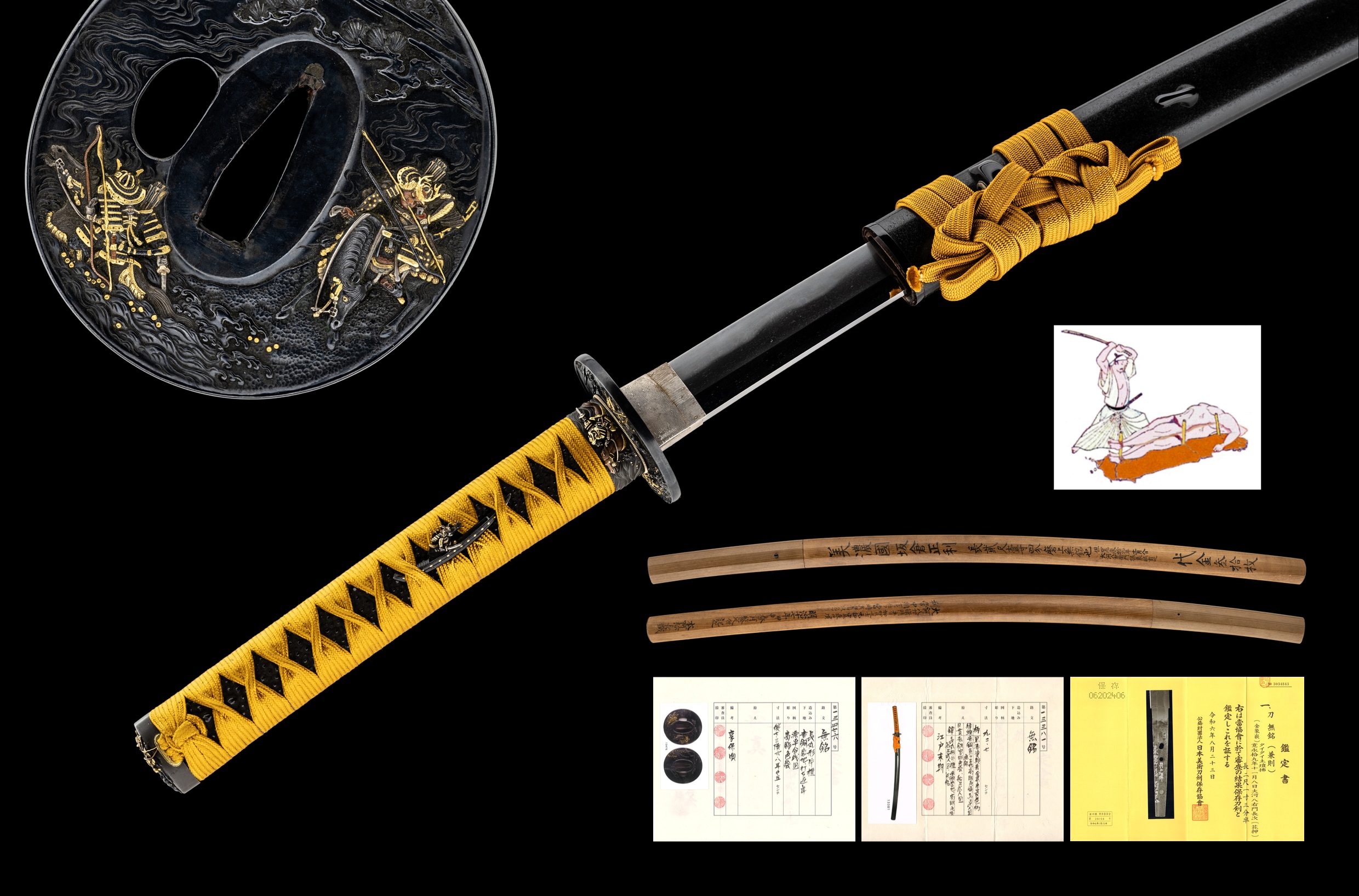
This riveting katana has been attributed to Kanenori (兼則), a distinguished smith of the prestigious San’ami (三阿弥) school in Mino province, working during the Eishô period, circa 1504~1521. The San’ami lineage traces directly back to the legendary Kaneuji — widely credited as the founding father of the Mino tradition — through his descendant Kanetomo. The school’s founder, known personally as Rokurôzaemon, signed his works Kanenori and was active between 1358 and 1426; subsequent generations carried that name and reputation forward into the Eishô era with skill and authority. Fujishiro ranks this line Chûjô-saku, and the sharpness rating of wazamonô is not honorary — this blade earned it.
The steel speaks for itself. The forging shows well-worked itame-hada interwoven with flowing mokume, accompanied by a distinct shirake-utsuri and lively chikei threading through the jigane. The hamon is the centrepiece — a brilliant, bubbling gunome-chôji-midare loaded with thick nie, punctuated by pointed togari and chôji, scattered tobiyaki islands, and frequent sunagashi and kinsuji running through the steel like heat lightning. The bôshi enters in midare-komi and turns back neatly in ko-maru with hakikake. Every element of this blade is exactly what you want from a late Muromachi Mino sword at its peak.
What elevates this sword into a different category entirely is the gold-inlaid (kinzôgan) cutting test inscription on the reverse of the shortened nakago. On the eighth day of the eleventh month of Kan’ei 19 (November 8th, 1642), tester Ôkawa Hachiemon Nagatsugu — a retainer of the Maeda lords of Kaga, documented in two separate scholarly publications including the Kenwa-roku (Sword Chronicles, Meiji 45 / 1912) — severed cleanly through the chunky shoulder area of a human torso in a taitai dodan-barai, one of the most demanding cuts in the tameshigiri repertoire. This sword executed that cut well over a century after its forging. The blade rests in a wonderfully old shirasaya bearing a sayagaki by Hon’ami Chôshiki dated to the spring of Meiji 17 (1884), one of the most extraordinary survivals of its kind. The accompanying late Edo period uchigatana-koshirae is a museum-grade ensemble in its own right, with exquisitely matched shakudô fittings throughout depicting the famous Ujigawa Battle of the Genpei War. Certified by both the NBTHK and NTHK-NPO, this is a superb samurai collectible of the very first order.
| Item Number | UJKA479 |
| Sword Type | Katana |
| Swordsmith | Attributed to Kanenori (mumei) |
| School | San’ami (三阿弥) |
| Province | Mino (Nôshû) |
| Period | Sue-Kotô, Late Muromachi (Eishô era: 1504~1521) |
| Nagasa | 64.7cm (o-suriage) |
| Sori | 1.4cm |
| Moto-haba | 2.85cm |
| Weight | 630g |
| Nakago | Suriage-nakago (shortened tang), 16.5cm, katte-sagari-yasurime (slanting file marks), 2 mekugi-ana |
| Jihada | Well-forged itame-hada with mokume-hada, shirake-utsuri and chikei |
| Hamon | Brilliant gunome-chôji-midare with sunagashi, kinsuji, tobiyaki and togari |
| Boshi | Midare-komi, ko-maru with hakikake |
| Certificates | NBTHK Hozon (Worthy of Preservation); NTHK-NPO Kanteishô (koshirae and tsuba certified as Authentic) |
| Fujishiro Rank | Chûjô-saku (above average swordsmith) |
| Sharpness Rating | Wazamonô (maker of sharp swords) |
| Sayagaki | Hon’ami Chôshiki — attributed to Sakakura Masatoshi, Mino no Kuni, dated Meiji 17 (1884) |
| Tameshigiri (JP) | (金象嵌)タイタイ土壇拂 寛永拾九年十一月八日大河八右衛門長次(花押) |
| Koshirae | Late Edo period (1780~1868) uchigatana-koshirae; kuro-ishime-ji-fû-nuri saya (black stone-surface lacquer) |
| Tsuba | Shakudô tsuba depicting the Battle of the Uji River (Ujigawa Battle) in high relief with gold and silver inlay; attributed to Den Efu Nara Toshimitsu (伝江府奈良利光), circa Kyôhô period (1716~1736); NTHK-NPO certified |
| Fuchi-kashira | Matching Battle of Uji River theme; shakudô with gold inlay; Edo period work by a different metalsmith |
| Menuki | Two large shakudô menuki depicting samurai advancing aboard boats, suggesting the Battle of Dan-no-ura (Genpei War) |
| Tsuka | Wrapped over black-lacquered samekawa (rayskin) with golden silk braid |
| Habaki | Silver habaki on a copper base |
| Video | Watch Pablo’s video presentation on YouTube |
| Catalogue | Catalogue 45 |
| Status | Sold |
| Includes | Shirasaya (with Hon’ami Chôshiki sayagaki, dated 1884), Edo koshirae, fabric bag, stand, kit, printed description |
⇩ Download PDF Description Description
The PDF contains full photography, detailed blade analysis, and all certification documentation.