
ITEM# UJKA480 – Catalogue 45 – Sold
A Gassan Sadayoshi Katana (月山貞吉)
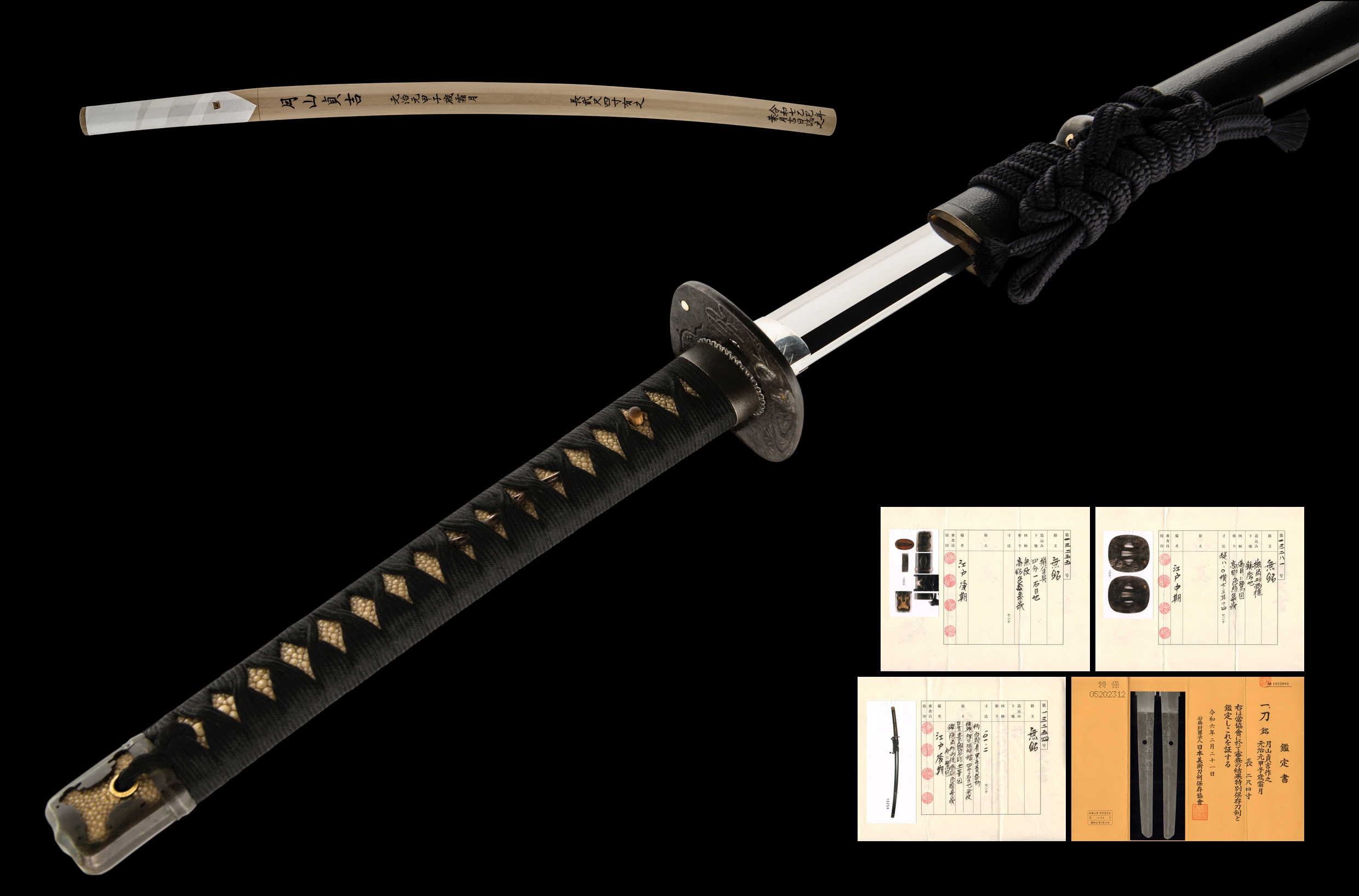
Gassan Sadayoshi (月山貞吉, 1781-1870) was the pivotal figure in the revival of one of Japan’s oldest swordsmithing lineages. The Gassan school traces its origins to the sacred mountains of Dewa Province, where early blades emerged from a world shaped by shugendô and mountain asceticism – a spiritual foundation that never fully left the tradition. Trained in Edo under Suishinshi Masahide (水心子正秀, 1760-1825), Sadayoshi studied a wide range of classical techniques before settling in Ôsaka, where he reestablished the Gassan name and worked closely with the Imperial family. Together with his adopted son, the great Gassan Sadakazu (月山貞一, 1836-1918), he successfully revived the school’s hallmark ayasugi-hada – the undulating wave-like grain pattern long thought lost since the Muromachi period – cementing the school’s legacy as one of the Shinshintô era’s finest.
Signed and precisely dated to the eleventh month of the first year of Genji (November 1864), this katana was forged just months before the fall of the Tokugawa shogunate, placing it among the final swords crafted in the Edo period by any master smith. At 72.8cm and 905g, it commands immediate attention – a powerful, muscular blade with a stately silhouette entirely in keeping with the Shinshintô aesthetic. The jihada is an expertly forged nagare-hada that flows into ayasugi with subtle itame-hada mixed throughout, displaying the clarity and consistency that mark carefully selected tamahagane in the hands of a master. The hamon is a suguha base with a soft touch of notare, the nioiguchi deep and luminous with fine nie, while splendid sunagashi and long, impressive kinsuji animate the interior. Shirake-utsuri rises gently through the ji. The bôshi is where this blade truly distinguishes itself: within the kissaki, rare kuichigai-ba is present – an area where the nioguchi overlaps for a noticeable distance, considered an exceptionally rare achievement and a direct testament to Sadayoshi’s absolute mastery of the temper line. The ubu nakago is signed in full with the date, with keshô-tsuki ô-sujikai file marks and a single mekugi-ana. A brand-new shirasaya bears a sayagaki by Tanobe-sensei, inscribed in August 2025 – a well-deserved tribute.
The koshirae is an outstanding late Edo-period handachi mounting, certified by the NTHK-NPO as authentic to the period and original to this katana. The kuro-ishime-ji-fû-nuri saya – lacquered in black with a stone-like textured surface – is paired with a superb matched set of shibuichi fittings (fuchi, kashira, kojiri, and dôrin) that project understated samurai authority. The tsuba is attributed to Nara Shigeyoshi of the mid-Edo period: a refined polished iron guard depicting a heron resting beneath a full moon among reeds and flowing water, with subtle silver and gold accents – poetically perfect for a smith whose name means Moon Mountain. The copper menuki are cast in the form of tsukushi (horsetail plants), a seasonally charged motif evoking renewal and perseverance. Every element of this presentation coheres: a major Shinshintô blade by a smith of the highest standing, in its original late Edo mounting, with full documentation at every level.
| Item number | UJKA480 |
| Sword type | Katana (ubu) |
| Swordsmith | Gassan Sadayoshi (shodai, first generation of modern era) |
| Swordsmith (JP) | 月山貞吉 |
| School | Gassan |
| Province | Dewa (school origin); Ôsaka (workshop) |
| Period | Shinshintô – late Edo period (Genji era: November 1864) |
| Signature | Omote: 月山貞吉作之 (Gassan Sadayoshi kore o tsukuru) / Ura: 元治元甲子歳霜月 (Genji gan kinoe-nedoshi Shimotsuki) |
| Nagasa | 72.8cm |
| Sori | 2.1cm |
| Moto-haba | 3.05cm |
| Saki-haba | 2.07cm |
| Kissaki | 4.36cm |
| Moto-kasane | 7.6mm |
| Saki-kasane | 4.4mm |
| Weight | 905g |
| Nakago | 21.7cm; ubu; ha agari kurijiri; keshô-tsuki ô-sujikai (slanting file marks with keshô); 1 mekugi-ana |
| Jihada | Nagare-hada leading to ayasugi with subtle itame-hada; plentiful chikei; excellent clarity and consistency |
| Hamon | Suguha with a touch of notare; deep luminous nioiguchi with fine nie; splendid sunagashi, kinsuji and kuichigai-ba |
| Boshi | Suguha with rare kuichigai-ba; brushed hakikake |
| Utsuri | Shirake-utsuri |
| Habaki | Silver habaki with diagonal rain file marks |
| Sayagaki | Nozomi-san (shodô artist) – inscribed in the 8th month, Reiwa 7 (August 2025) |
| Certificates | NBTHK Tokubetsu Hozon (Especially Worthy of Preservation) – issued Reiwa 6 (2024), February 21; NTHK-NPO Kanteishô x3 – koshirae, fuchi-kashira, and tsuba each certified as Authentic |
| Fujishiro rank | Jô-saku (superior swordsmith) |
| Koshirae | Edo handachi koshirae – kuro-ishime-ji-fû-nuri saya (black stone-textured lacquer); late Edo period (1780-1868); NTHK-NPO certified as original to this katana |
| Tsuba | Polished iron; attributed to Nara Shigeyoshi (mid-Edo, Nara school); heron beneath full moon with reeds and water; silver and gold accents; NTHK-NPO Kanteishô certified |
| Fuchi-kashira | Shibuichi (1/4 silver, 3/4 copper); matched set with kojiri and dôrin; NTHK-NPO Kanteishô certified |
| Menuki | Copper; extra-long; tsukushi (horsetail plant) motif |
| Tsuka | Black tsuka-ito over same; tsukushi menuki |
| Catalogue | Catalogue 45 |
| Status | Sold |
| Includes | Shirasaya (brand new, with Tanobe sayagaki), Edo handachi koshirae, fabric bags, stand, kit, printed description |