
ITEM# UJKA379 – Catalogue 34 – Sold
A Kagehide Tachi (景秀)
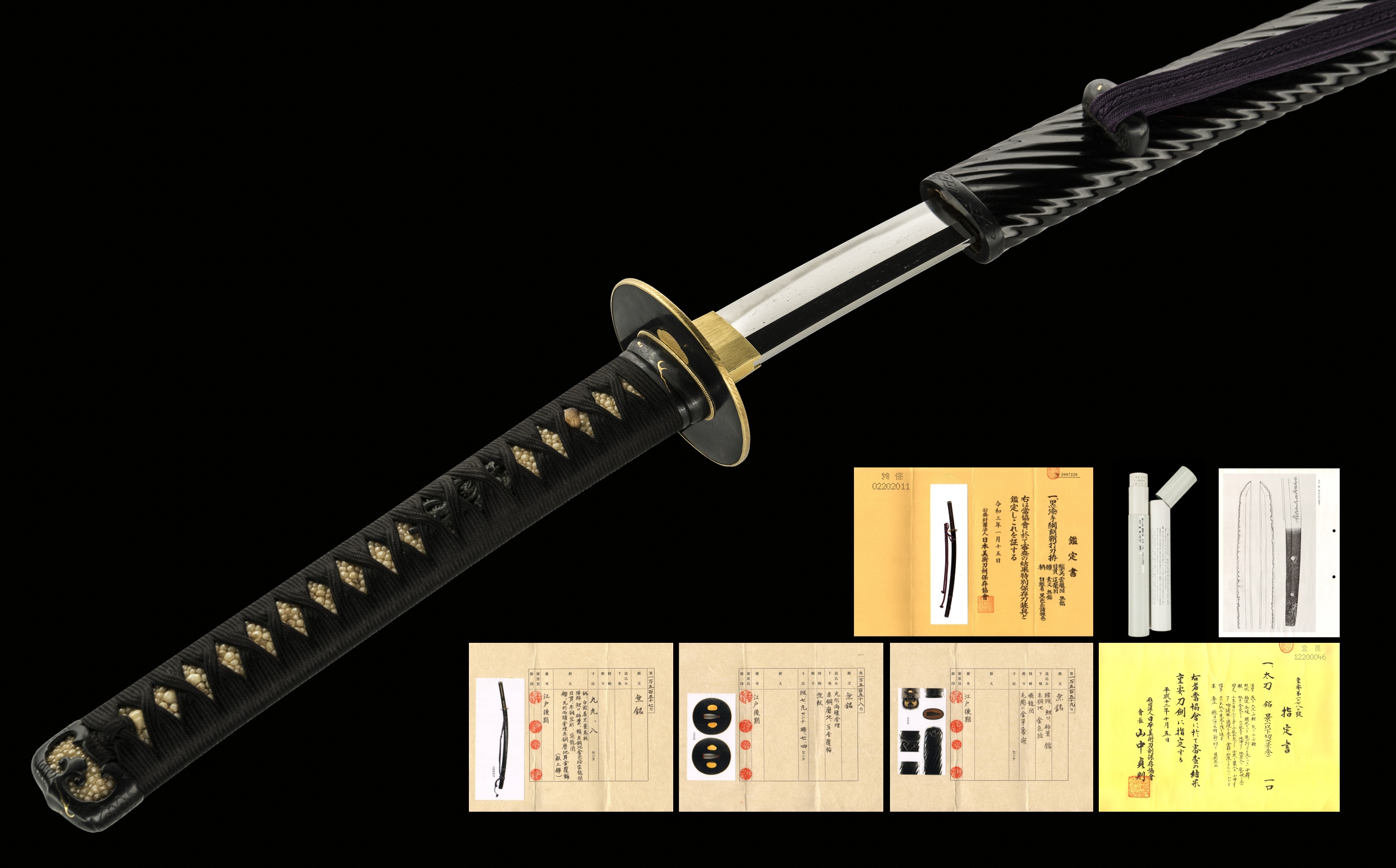
Kagehide is traditionally regarded as the younger brother of Mitsutada, placing him at the very roots of the Bizen-Osafune school – that extraordinary lineage of smiths that would prosper for centuries and produce some of Japan’s most celebrated blades. Active around the Shôgen era (1259-1260), Kagehide worked in a style closely related to Mitsutada’s, favouring dense arrangements of chôji-midare elements with more prominent togari than his brother, giving his hamon a sharper, more serrated quality. Extant signed works are extraordinarily rare: there are only eleven known in existence. The most famous, the meibutsu tachi Kuronbogiri, once owned by warlord Date Masamune, is today designated as a jûyô-bunkazai (Important Cultural Property). This tachi is one of the eight Jûyô-designated signed works – a blade of genuine historical significance.
The nakago is suriage (shortened), bearing the large, thickly chiselled character 景 (Kage) and the opening stroke of 秀 (hide), the remainder lost to the shortening. Precisely because signed Kagehide blades are so few, the NBTHK Jûyô committee noted that this blade serves as a critical reference for understanding the full range of Kagehide’s styles, and that the surviving signature – even partially – leaves no room for doubt about authorship. The blade passed the 46th Jûyô Shinsa in October 2000.
The jihada is a standing-out itame mixed with mokume, animated throughout with ji-nie, chikei, and a vivid midare-utsuri – precisely the steel quality associated with the finest Kamakura Bizen work. The hamon is a ko-nie-laden ko-gunome mixed with ko-chôji, ko-midare, ashi, yô, kuichigai-ba, fine tobiyaki, and remarkable threads of kinsuji and sunagashi; certain areas are particularly nie-laden, with nie-zukure also present. The boshi runs in notare-komi with a brief maru-kaeri. Accompanying the blade is a magnificent matched late Edo tachi-uchigatana-koshirae with cloud-dragon fittings crafted by the Umetada school and a shakudô and gold tsuba by the Yoshioka school – a presentation befitting a tachi that would have been owned by the most prominent members of the samurai elite. The shirasaya carries a sayagaki by Tanobe Michihiro (Tanzan-sensei).
| Item Number | UJKA379 |
| Sword Type | Tachi |
| Swordsmith | Kagehide |
| Swordsmith (JP) | 景秀 |
| Signature | Kage [ika-kire] 景「以下切」- “Kage” with remainder cut off (Kagehide, 景秀) |
| School | Bizen-Osafune |
| Province | Bizen |
| Period | Kôtô – Mid-Kamakura period (Shôgen era: 1259-1260) |
| Nagasa | 69.4cm (suriage) |
| Sori | 2.70cm |
| Moto-haba | 2.75cm |
| Nakago | Suriage, 18.6cm, shallow kurijiri, two mekugi-ana |
| Jihada | Standing-out itame mixed with mokume, ji-nie, chikei, midare-utsuri |
| Hamon | Ko-nie-laden ko-gunome mixed with ko-chôji, ko-midare, ko-ashi, yô, kuichigai-ba, fine tobiyaki, kinsuji, sunagashi; certain areas particularly nie-laden with nie-zukure |
| Boshi | Notare-komi with brief maru-kaeri |
| Certificates | NBTHK Jûyô Tôken (46th session, October 5, 2000); NBTHK Tokubetsu Hozon (koshirae) |
| Fujishiro Rank | Jôjô-saku |
| Sayagaki | Tanobe Michihiro (Tanzan-sensei) |
| Koshirae | Matching tachi-uchigatana-koshirae with cloud-dragon fittings, Umetada school, late Edo period. NBTHK Tokubetsu Hozon certified. |
| Tsuba | Shakudô and gold, Yoshioka school (Edo) |
| Catalogue | Catalogue 34 |
| Status | Sold |
| Includes | Shirasaya and bags; matching Edo koshirae; NBTHK Jûyô Tôken certificate; NBTHK Tokubetsu Hozon certificate (koshirae); sword stand; cleaning kit; printed description |