
ITEM# UJKA460 – Catalogue 43 – Sold
A Yukimitsu Katana (豊後高田住藤原行光)
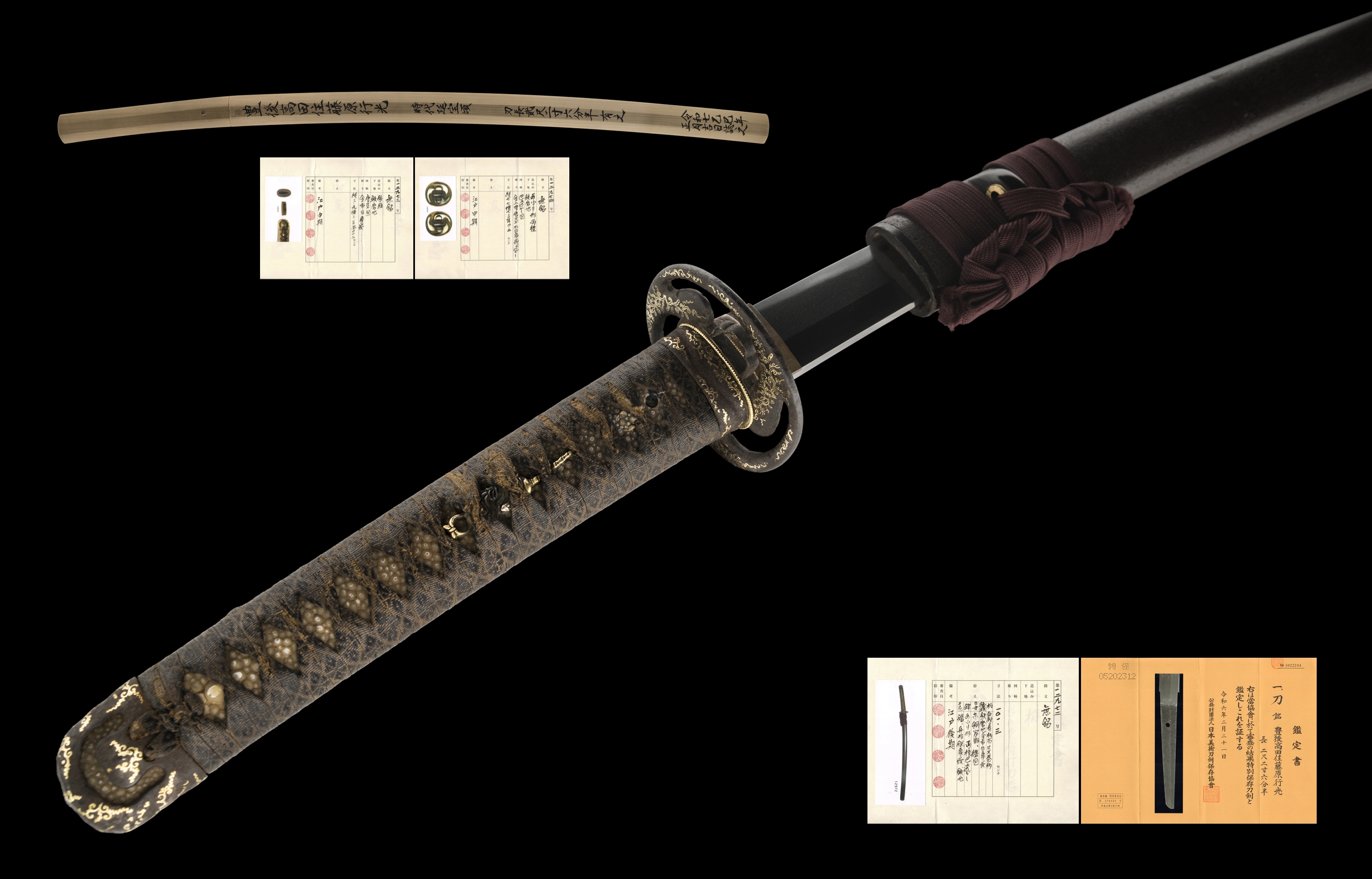
The Takada school of Bungo province in Kyûshû traces its origins to Tomoyuki, who founded the tradition circa 1334-1338 at the dawn of the Nambokuchô period. After absorbing Bizen techniques in present-day Okayama, Tomoyuki returned to establish a school whose distinctive eclecticism would endure well into the shintô era. This katana was forged by Yukimitsu – born Nakama Kanzaemon – a representative smith of that tradition, active circa the Enpô (1673-1681) and Jôkyô (1684-1688) eras. He signed the blade in full as Bungo Takada-jû Fujiwara Yukimitsu, a distinction worth noting as some Yukimitsu swords carry only the shorter Fujiwara Yukimitsu signature.
What sets this blade apart is the range of traditions compressed into a single sword. The wide shinogi-ji and flowing nagare-hada speak to a robust Yamato influence, while the hamon – a vigorous togari-gunome in nie-deki – carries unmistakably Mino characteristics, its yahazu-ba and koshibiraki punctuated by a surging tôran as the hamon approaches the kissaki. Even the falling yô in the yaki-ba nods to Yamashiro aesthetics. The bôshi resolves into a komaru-kaeri with a striking kaen boshi that resembles a candle flame. There is also a kirikomi – a defensive battle scar on the mune in the monouchi zone – a prized mark intentionally preserved by polishers as a testament to the sword’s working life.
The late Edo period uchigatana-koshirae has a real samurai feel: a brown cha-ishime-nuri lacquered saya, iron fittings carrying swirling gold arabesque motifs in a matching set – the tsuba attributed to the Nishigaki school of Higo province with a tomoe sukashi design, the fuchi-kashira attributed to the Bizen Shôami school. The tsuka is linen-wrapped with a noble hanabishi pattern, set with menuki depicting umajirushi – the tall battle banners once carried by samurai commanders into the field. The koshirae is complete and holds its own NTHK-NPO Kanteisho certificates of authenticity. An ideal sword for the collector who wants breadth as well as depth.
| Item Number | UJKA460 |
| Sword Type | Katana |
| Swordsmith | Fujiwara Yukimitsu (1st gen.), Bungo Takada |
| Swordsmith (JP) | 豊後高田住藤原行光 |
| Signature | Bungo Takada-jû Fujiwara Yukimitsu |
| School | Takada |
| Province | Bungo (Kyûshû) |
| Period | Shintô – Early Edo period (Enpô era: 1673-1681) |
| Nagasa | 68.7cm |
| Sori | 1.5cm |
| Moto-haba | 2.89cm |
| Weight | 630g |
| Nakago | Ubu (original, unaltered); katte-sagari-yasurime (slanting file marks); ha agari kurijiri nakago-jiri; one mekugi-ana |
| Jihada | Nagare-hada mixed with mokume-hada with chikei |
| Hamon | Togari-gunome in nie-deki mixed with toran, koshibiraki, yahazu-ba and kaen-bôshi |
| Boshi | Komaru-kaeri with kaen boshi |
| Certificates | NBTHK Tokubetsu Hozon (sword); NTHK-NPO Kanteisho (tsuba, fuchi-kashira and koshirae) |
| Fujishiro Rank | Chujô-saku (above average) |
| Sayagaki | Nozomi-san (shodo artist) – Bungo Takada-jû Fujiwara Yukimitsu, Enpô era; dated the first month, Reiwa 7 (January 2025) |
| Koshirae | Late Edo period uchigatana-koshirae (cha-ishime-nuri saya, circa 1780-1868); NTHK-NPO certified authentic |
| Tsuba | Iron, tomoe sukashi design with gold arabesque inlay; attributed to Nishigaki school, Higo province; NTHK-NPO certified authentic |
| Fuchi-kashira | Iron with crosshatched gold arabesque inlay; attributed to Bizen Shôami school (Mid Edo period: 1700-1780); NTHK-NPO certified authentic |
| Menuki | Gold umajirushi (battle banner) motif |
| Tsuka | Linen-wrapped with hanabishi pattern |
| Habaki | Single |
| Catalogue | Catalogue 43 |
| Status | Sold |
| Includes | Shirasaya, Edo koshirae, fabric bags, stand, kit, printed description |