
ITEM# UJKA452 – Catalogue 44 – Sold
A Shodai Kanewaka Katana (賀州住兼若造)
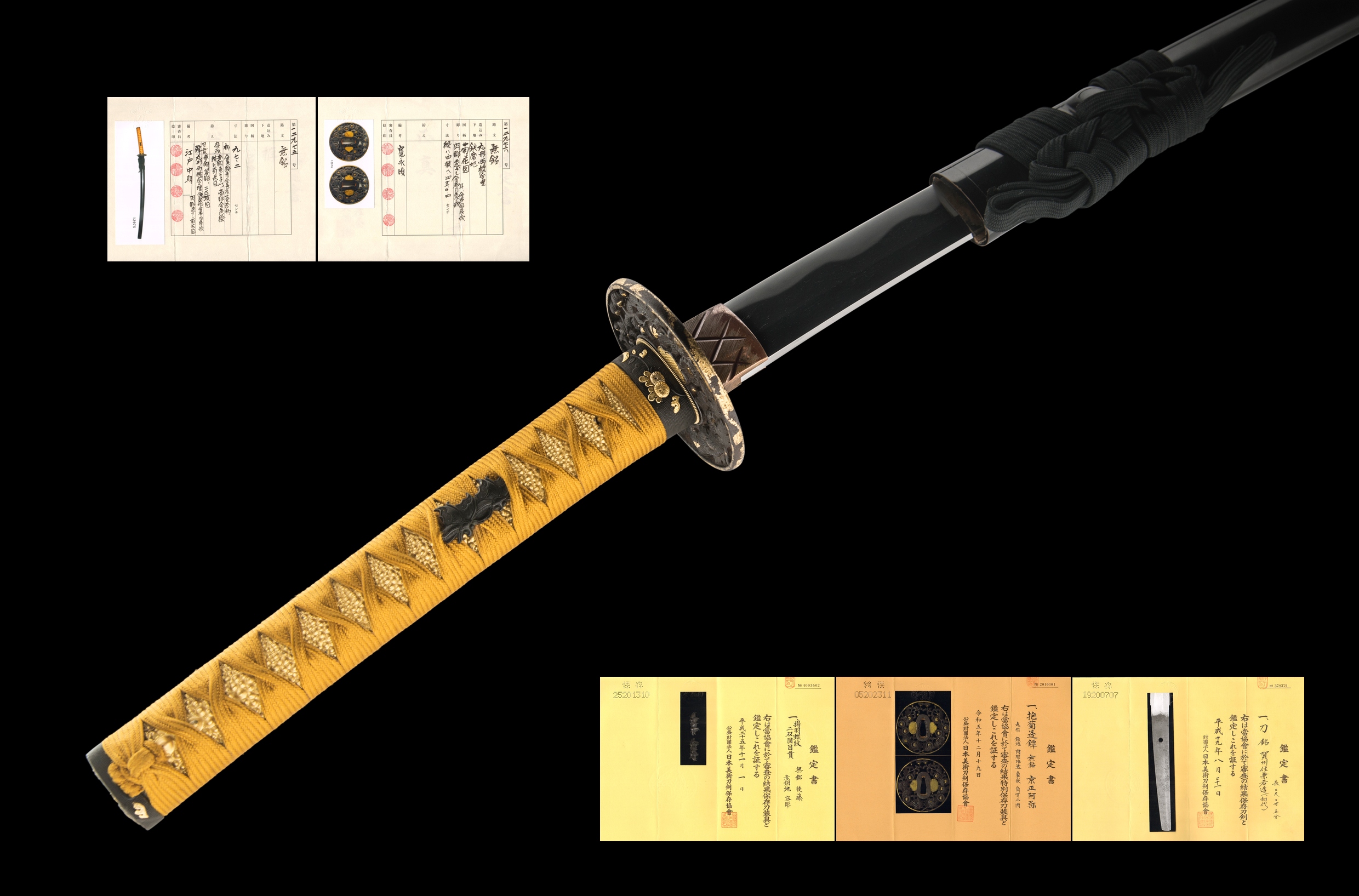
The Kanewaka lineage traces its origins to Mino province during the Bunmei era (1469-1487), the founding smith said to be a descendant of the great Shizu Saburo Kaneuji. Fast forward to 1605, and the fifth generation, born Tsujimura Jinroku, made the journey to Kaga province – from either Mino or Inuyama in Owari – where he founded the prestigious Kaga Kanewaka school and signed as Kashû (Gashû) jû Kanewaka. He received the honorary title Etchu no Kami around 1620 and died in 1628. His fame was such that he was referred to as Kaga Masamune – high praise indeed – and his blades commanded prices so steep that a famous nihontô saying arose: those samurai who wanted a Kanewaka had to spend so much that they had to sell their daughters. Pieces signed as Kanewaka are considered rare; from 1621 he largely signed as Takahira (高平).
This fine ubu-nakago katana carries the confident Keichô shintô sugata – a relatively shallow curvature and an extended chû-kissaki – that defines his early output from the Mino tradition. The jihada is itame mixed with nagare-hada, packed with plentiful dark swirling chikei and a distinctive ring of tobiyaki appearing in the ji. The bright gunome-midare hamon dramatically hugs the ha-saki (edge) in parts, with captivating golden lines of kinsuji and a wonderful stream of sunagashi adding further depth. Collectors should note the areas of hada-ware (stable openings at the steel folds in the yakiba) – non-fatal and stable, but worth seeing past to appreciate the full vitality of this four-hundred-year-old blade.
In wealthy Kaga province – ruled by the powerful Maeda clan from their base in Kanazawa, a city renowned across Japan for its gold leaf artistry – the samekawa (ray skin) wrapping the tsuka was specially lacquered in gleaming gold and further braided in gold silk, all executed by master craftsmen. The menuki are a superb pair of swallowtail butterfly crests in shakudô by the Gotô school (NBTHK Hozon), beautifully complementing the fuchi-kashira depicting butterflies and chrysanthemum. The outstanding centrepiece is the Kyô-Shôami iron tsuba – round, pierced with daki-giku (embracing chrysanthemum) openwork, its mimi adorned with nunome-zôgan gold crosshatch inlay – awarded NBTHK Tokubetsu Hozon in 2023. The complete koshirae holds an NTHK-NPO Kanteishô Certificate of Authenticity. A celebratory Kaga sword in every sense.
| Item Number | UJKA452 |
| Sword Type | Katana |
| Swordsmith | Shodai Kanewaka (first generation) |
| Swordsmith (JP) | 賀州住兼若 (初代) |
| Signature | Kashû jû Kanewaka tsukuru (shodai) |
| School | Kaga Kanewaka |
| Province | Kaga |
| Period | Shintô – Momoyama period (Keichô era: 1596-1615) |
| Nagasa | 68.2cm |
| Sori | 1.2cm |
| Moto-haba | 2.98cm |
| Weight | 645g |
| Nakago | Ubu (original, unaltered tang); sujikai-yasurime (slanting file marks); 1 mekugi-ana |
| Jihada | Itame mixed with nagare-hada with plentiful chikei, tobiyaki with ji-nie |
| Hamon | Bright gunome-midare with dramatic dips, togari, kinsuji and sunagashi |
| Certificates | NBTHK Hozon (sword and menuki); NBTHK Tokubetsu Hozon (tsuba); NTHK-NPO Kanteishô (tsuba and koshirae) |
| Fujishiro Rank | Jôjô-saku (highly superior swordsmith) |
| Sharpness Rating | Ô-wazamonô (supremely sharp sword maker) |
| Koshirae | Kuro-ronuri saya uchigatana-koshirae (黒呂塗鞘打刀拵); saya lacquered in glossy black; Middle Edo period (1700-1780); NTHK-NPO Kanteishô |
| Tsuba | Kyô-Shôami school, mumei (unsigned); iron, round shape; three-dimensional openworks depicting daki-giku (embracing chrysanthemum) motif; nunome-zôgan (crosshatch inlay) on mimi; NBTHK Tokubetsu Hozon |
| Fuchi-kashira | Depicting butterflies and chrysanthemum in gold on shakudô ground |
| Menuki | Swallowtail butterfly crest; shakudô, three-dimensional; Gotô school, mumei; NBTHK Hozon |
| Tsuka | Samekawa (ray skin) lacquered in gold; braided in gold silk |
| Habaki | Copper habaki, Kaga style (Kaga-habaki) |
| Catalogue | Catalogue 44 |
| Status | Sold |
| Includes | Shirasaya, Edo koshirae, fabric bags, stand, kit, printed description |