
ITEM# UJKA436 – Catalogue 41 – Sold
A Hojoji Masateru Katana (越前守法城寺橘正照)
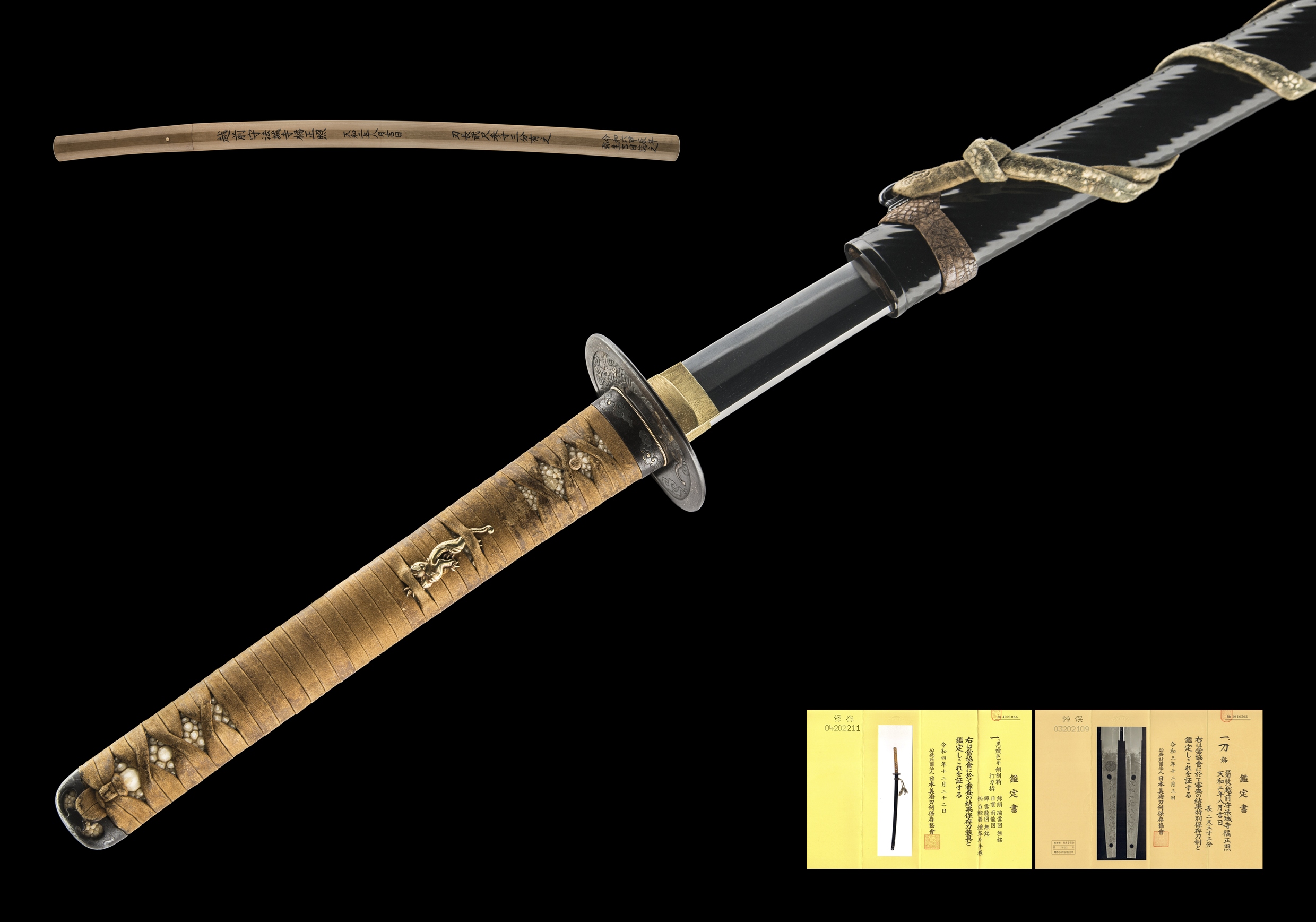
Swordsmith Masateru first studied under shodai Hôjôji Masahiro, founder of the shintô-era Edo Hôjôji school, originally established by Kunimitsu in the Hôjôji district of Tajima province circa 1362. After completing his training under Masahiro, Masateru travelled to Kyôto and furthered his studies under the second-generation swordsmith Kinmichi of the famed Mishina school. That master-student relationship earned Masateru the rare privilege of carving a kiku-mon – the imperial chrysanthemum crest – onto his tangs, a distinction visible on this very blade.
Signed and dated to a lucky day in the eighth month of Tenna 2 (August 1682), this katana was produced at the peak of Masateru’s career. Light and slender with shallow curvature, it was built for fast drawing from a standing position. Its hamon is genuinely distinctive: a wide suguha that breaks gently into notare, the whole wrapped in a thick, luminous nioguchi that blazes under light like a comet crossing the night sky. The ko-itame steel, alive with ji-nie, provides a fine and tight canvas for that activity. NBTHK examiners awarded Tokubetsu Hozon – the second-highest certification – in December 2021.
The Edo-period uchigatana-koshirae is a worthy companion. Its saya is lacquered in glossy black with slanting tazuna-kizami carving, and the fittings carry a unified theme of rain and cloud dragons across iron tsuba, fuchi-kashira, and gold menuki – a complete decorative programme that earned its own NBTHK Hozon certificate in 2022. The shirasaya carries a sayagaki by Nozomi-san, inscribed in the third month of Reiwa 6 (March 2024), Year of the Dragon. An ideal first sword for a serious new collector.
| Item Number | UJKA436 |
| Sword Type | Katana |
| Swordsmith | Echizen no Kami Hôjôji Masateru (first generation) |
| Swordsmith (JP) | 越前守法城寺橘正照 |
| Signature | (Kikumon) Echizen no Kami Hôjôji Tachibana Masateru |
| Date | Tenna ninen hachigatsu kichijitsu – Tenna 2 (August 1682) |
| School | Hôjôji |
| Province | Kyôto (Yamashiro) |
| Period | Shintô – Early Edo period (Tenna era: 1681-1684) |
| Nagasa | 70.7 cm |
| Sori | 0.9 cm |
| Moto-haba | 2.76 cm |
| Weight | 715 g |
| Nakago | Ubu (trimmed nakago-jiri); sujikai-yasurime (diagonal file marks); 2 mekugi-ana |
| Jihada | Ko-itame-hada with ji-nie |
| Hamon | Hiro-suguha and notare with thick nioguchi in nie-deki |
| Certificates | NBTHK Tokubetsu Hozon (blade, Reiwa 3 / December 2021); NBTHK Hozon (koshirae, Reiwa 4 / December 2022) |
| Fujishiro Rank | Chûjô-saku |
| Sayagaki | Nozomi-san (shodô artist) – inscribed in the 3rd month, Reiwa 6 (March 2024) |
| Koshirae | Edo uchigatana-koshirae; kuro-roiro tazuna-kizami saya lacquered in glossy black |
| Tsuba | Iron, cloud dragon motif, unsigned |
| Fuchi-kashira | Auspicious cloud (zuiun) motif, unsigned |
| Menuki | Rain dragon motif, gold |
| Tsuka | White same wrapped in katatemaki style with smoked leather |
| Habaki | Gold niju habaki with kiri file marks |
| Catalogue | Catalogue 41 |
| Status | Sold |
| Includes | Shirasaya, Edo koshirae, fabric bags, stand, kit, printed description |