
ITEM# UJKA395 – Catalogue 38 – Sold
A Ryôkai Katana (了戒)
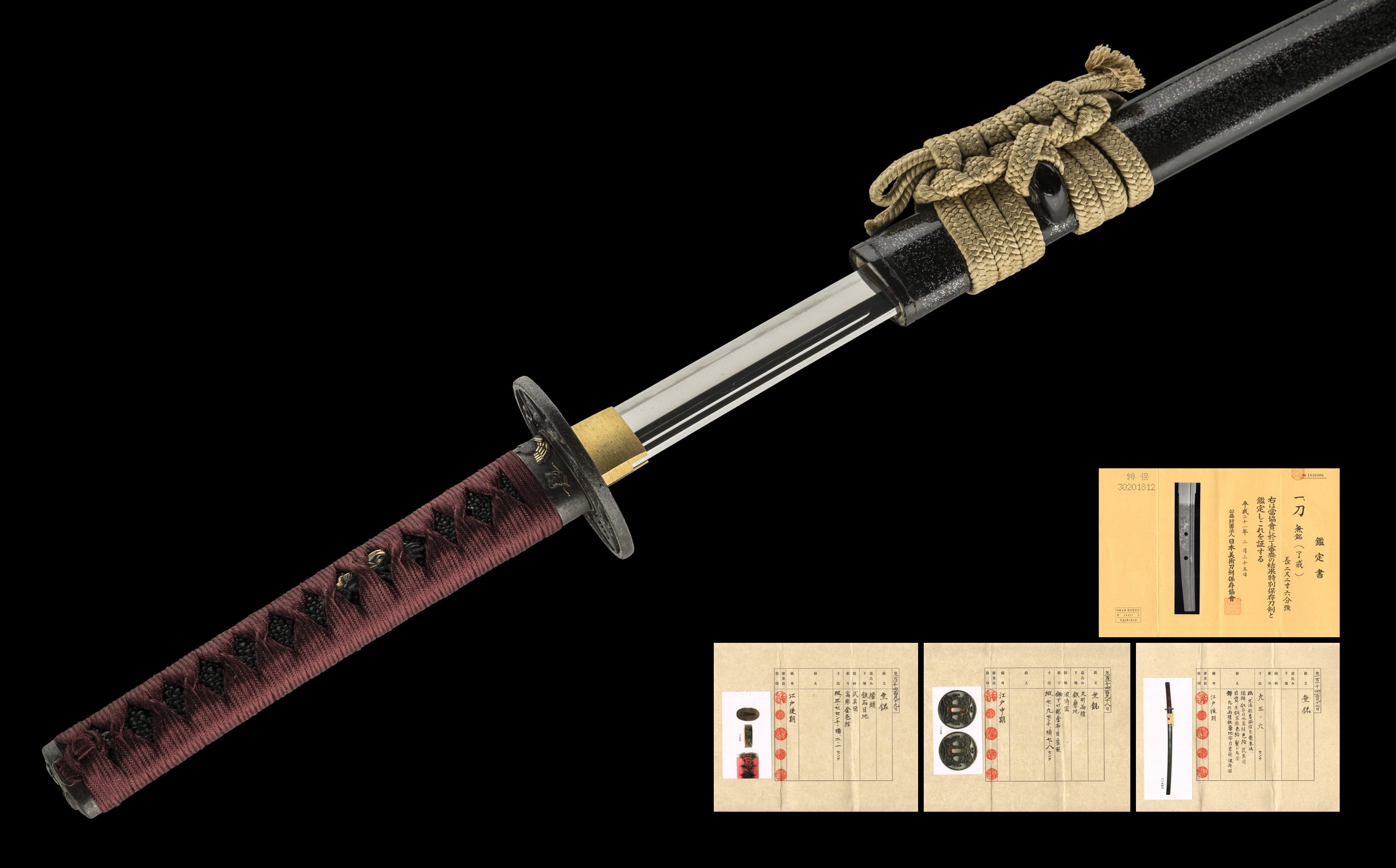
*Ryôkai* is said to be the son of grandmaster *Rai Kunitoshi*, one of the most celebrated smiths of the Kamakura period. He left the Rai family at the age of 16 and took the priest name *Ryôkai*. Existing dated signatures range between the 5th year of *Shôô* era (1292) and the 2nd year of *Enkyô* era (1309) – dates that firmly support his close relation to Rai Kunitoshi, whose active period was around *Kôan* era (1278~1288). Ryôkai was known to produce rather slender *tachi*, and this sword carries all the hallmarks of his hand. It was once a long tachi that was greatly shortened to its *ô-suriage* form in approximately the late Muromachi to early Edo period, losing its signature in the process.
The *jigane* is a dense *ko-itame* with fine *ji-nie*, showing some clear *masame-hada* and *shirake-utsuri* – characteristics closely associated with the Rai school tradition. The upper *kissaki* area is particularly striking, with beautifully forged layers of free-flowing straight grain *masame-hada* folded and preserved for us to appreciate over 700 years later. The *hamon* carries a distinctly bluish tint – a quality feature often seen on better Kotô-period blades – and features an eclectic mix of *suguha* with *ko-gunome* and *ko-chôji*, with plenty of *ko-ashi*, *kinsuji*, and long streams of *sunagashi* running through it. The *nakago* features *kaki-tôshi* – grooves extending right through the butt end of the tang – and retains a gold-wrapped *habaki* with crisp horizontal file marks.
The *koshirae* is a magnificent *aogai-mijin-nuri* uchigatana mounting from the late Edo period (1780~1867), its saya lacquered in dense mother-of-pearl that shimmers like stars scattered across the night sky. The *tsuba* is a polished iron piece attributed to the *Kyô-Shôami* school, circa 1700~1780, depicting rolling waves in a quadratic design within a circular form, with an impressively preserved *nunome-zôgan* gold inlay pattern etched around the rim. The iron *fuchi-kashira* features elements of samurai weaponry and armour and has been certified to the *Tôryûsai* school of Edo from the late Edo period. The *menuki* are tethered horses of black *shakudô* and gold – a nod to the mounted warriors who once carried *tachi* such as this. Both the koshirae and its fittings carry NTHK-NPO Kanteishô certificates of authenticity. Ryôkai is ranked *jô-saku* – a superior swordsmith – an impressive achievement given the calibre of smiths at the top of their craft at the close of the golden Kamakura period.
| Item Number | UJKA395 |
| Sword Type | Katana (ô-suriage) |
| Attribution | Attributed to Ryôkai (mumei, o-suriage) |
| School | Rai |
| Province | Yamashiro |
| Period | Kotô – Late Kamakura (Shôô~Enkyô eras: 1292~1309) |
| Nagasa | 68.7cm |
| Sori | 0.8cm |
| Moto-haba | 2.55cm |
| Weight | 585g |
| Nakago | Ô-suriage mumei, kaki-tôshi |
| Jihada | Ko-itame with ji-nie, masame-hada and shirake utsuri |
| Hamon | Suguha with ko-gunome, ko-ashi, kinsuji and sunagashi |
| Horimono | Short bôhi on both sides with kaki-tôshi running through the nakago |
| Certificates | NBTHK Tokubetsu Hozon; NTHK-NPO Kanteishô (tsuba, koshirae & fittings) |
| Fujishiro Rank | Jô-saku |
| Koshirae | Aogai-mijin-nuri uchigatana koshirae, Late Edo period (1780~1867) |
| Tsuba | Polished iron, rolling waves with nunome-zôgan gold inlay, attributed to Kyô-Shôami school, circa 1700~1780. NTHK-NPO Kanteishô. |
| Fuchi-kashira | Iron, samurai weaponry and armour motifs, attributed to Tôryûsai school, Edo (Tokyo), Late Edo period. NTHK-NPO Kanteishô. |
| Menuki | Tethered horses in black shakudô and gold |
| Tsuka | Black-lacquered samekawa, wine-red silk braid |
| Habaki | Gold-wrapped, horizontal file marks |
| Catalogue | Catalogue 38 |
| Status | Sold |
| Includes | Shirasaya, Edo koshirae, fabric bags, stand, kit, booklet, description |