
ITEM# UJKA326 – Catalogue 31 – Sold
A Tsunatoshi Katana (米澤士長運齋綱俊造之)
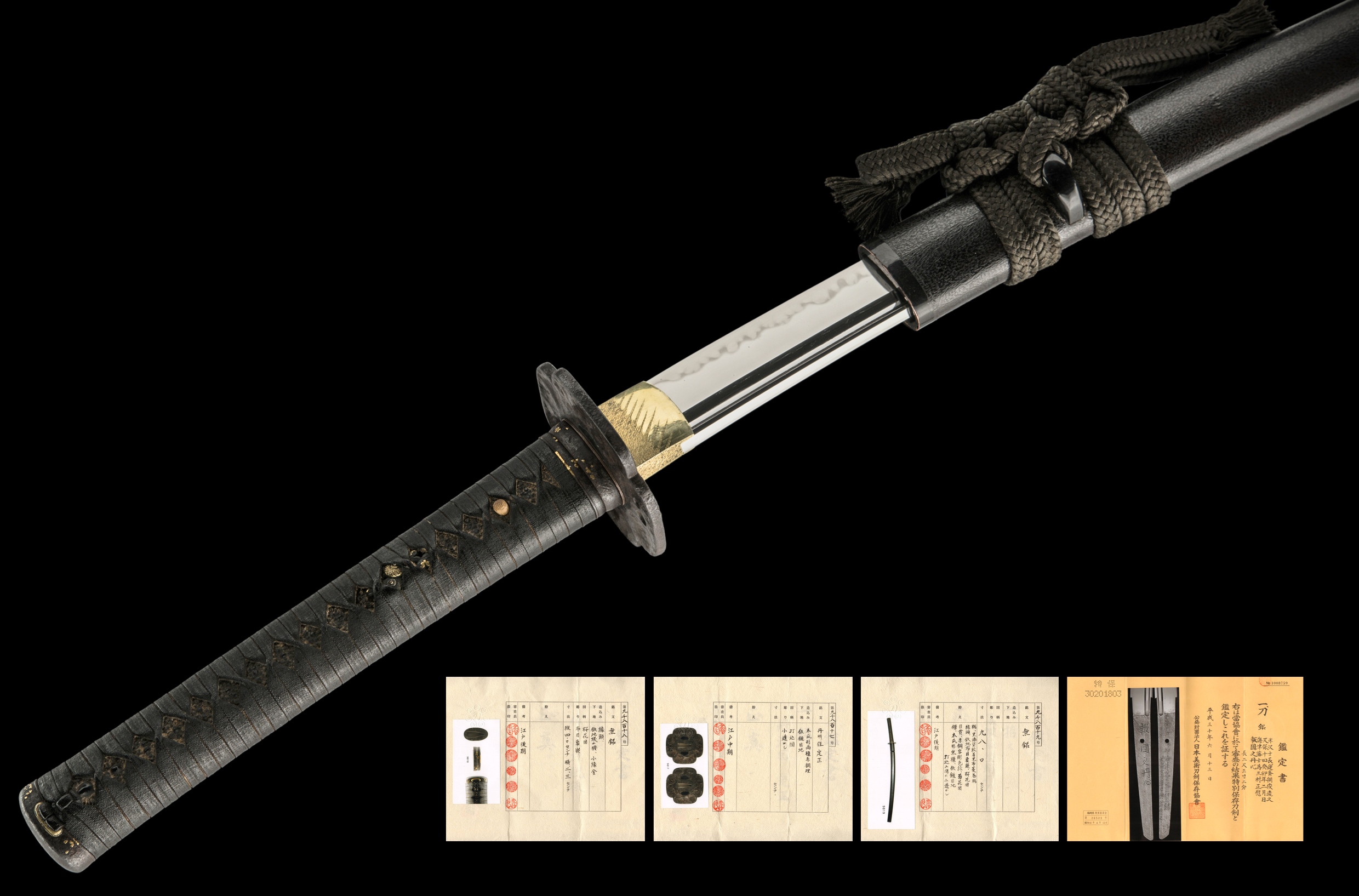
First-generation master swordsmith Chôunsai Tsunatoshi was born Katô Hachirô, a student of grandmaster Suishinshi Masahide – just as his father Katô Kunihide had been before him. Tsunatoshi moved to Edo during the Bunsei era (1818-1830) where he served in the residence of the Uesugi family, the daimyô of Yonezawa domain, carrying the honorary title Chôunsai. He is ranked Jo-saku by Fujishiro – a superior swordsmith – and this katana is a fine testament to why.
This remarkable and rare katana was commissioned by samurai Mimura Tadashi, a retainer of the Kaizu fief, which was controlled by the Takasu-Matsudaira branch of the ruling Tokugawa family. The ubu-nakago carries a lengthy inscription recording the commission in full: crafted by Chôunsai Tsunatoshi, retained by the Yonezawa fief, completed in February 1843 – the Year of the Hare. On the reverse, Mimura Tadashi had the characters Hôkoku no Tanshin boldly chiselled as a declaration of his loyalty and patriotism for the Tokugawa family. A sword with a story.
The blade itself is wide and formidable, weighing nearly one kilogram with a thick kasane (spine) – densely forged in nioi-deki with a beautifully active gunome-choji-midare hamon punctuated by tobiyaki, kinsuji, and sunagashi. A long bo-higroove with maru-dome runs the length of the blade, meeting the yokote at the tip. The boshi is a flowing hakikake midare-komi. Tsunatoshi forged blades so tightly packed that the surface grain approaches the mirror-like finish known as muji-hada – this example is no exception. The sword comes fitted in an impressive Edo uchigatana-koshirae lacquered in black with a wrinkled leather-like textured saya, and is balanced with an imposing mokko-gata iron tsuba signed by Tanba province metalsmith Sadamasa.
| Item Number | UJKA326 |
| Sword Type | Katana |
| Swordsmith | Chôunsai Tsunatoshi (shodai – first generation) |
| Swordsmith (JP) | 米澤士長運齋綱俊 |
| Signature | Yonezawa-shi Chôunsai Tsunatoshi kore o tsukuru / Tenpô jû-yon mizunoto-usagidoshi nigatsu hi / Kaizu hanshi Mimura Tadashi nagusami no tame / Hôkoku no Tanshin |
| Date | Tenpô 14, mizunoto-usagidoshi, nigatsu (February 1843) |
| Province | Musashi (Edo) |
| Period | Shinshintô – Late Edo (Tenpô era: 1830-1844) |
| Nagasa | 70.45cm (2-shaku 3-sun 2-bu) |
| Sori | 2.15cm |
| Moto-haba | 3.2cm |
| Weight | 925g |
| Nakago | Ubu, kesho-sujikai-yasurime (cosmetic diagonal file marks), 1 mekugi-ana |
| Jihada | Densely forged ko-itame hada in nioi-deki with light shirake utsuri |
| Hamon | Gunome-choji-midare with tobiyaki, ashi, kinsuji and sunagashi |
| Boshi | Hakikake (brushed) with midare-komi |
| Certificates | NBTHK Tokubetsu Hozon; NTHK-NPO Kanteisho (koshirae, tsuba & fuchi-kashira) |
| Fujishiro Rank | Jo-saku |
| Koshirae | Edo uchigatana-koshirae (kuro-jiwa-kawa-nuri saya) – Late Edo period (1780-1867) |
| Tsuba | Mokko-gata iron tsuba with hammered surface, signed Tanba-ju Sadamasa; NTHK-NPO Kanteisho |
| Fuchi-kashira | Iron with gold crosshatch in falling sakura motif, attributed to Higo province, Late Edo; NTHK-NPO Kanteisho |
| Menuki | Three-dimensional imperial kiku (chrysanthemum) flowers |
| Tsuka | Black nuno (linen) hishimaki style over black-lacquered samekawa (ray skin) |
| Habaki | Gold habaki with diagonal file marks |
| Catalogue | Catalogue 31 |
| Status | Sold |
| Includes | Shirasaya, Edo koshirae, bags, stand, kit, DVD, booklet, printed description |