
ITEM# UJKA324 – Catalogue 33 – Sold
A Chikuzen Yasusada Katana (筑州源信国常四郎安貞)
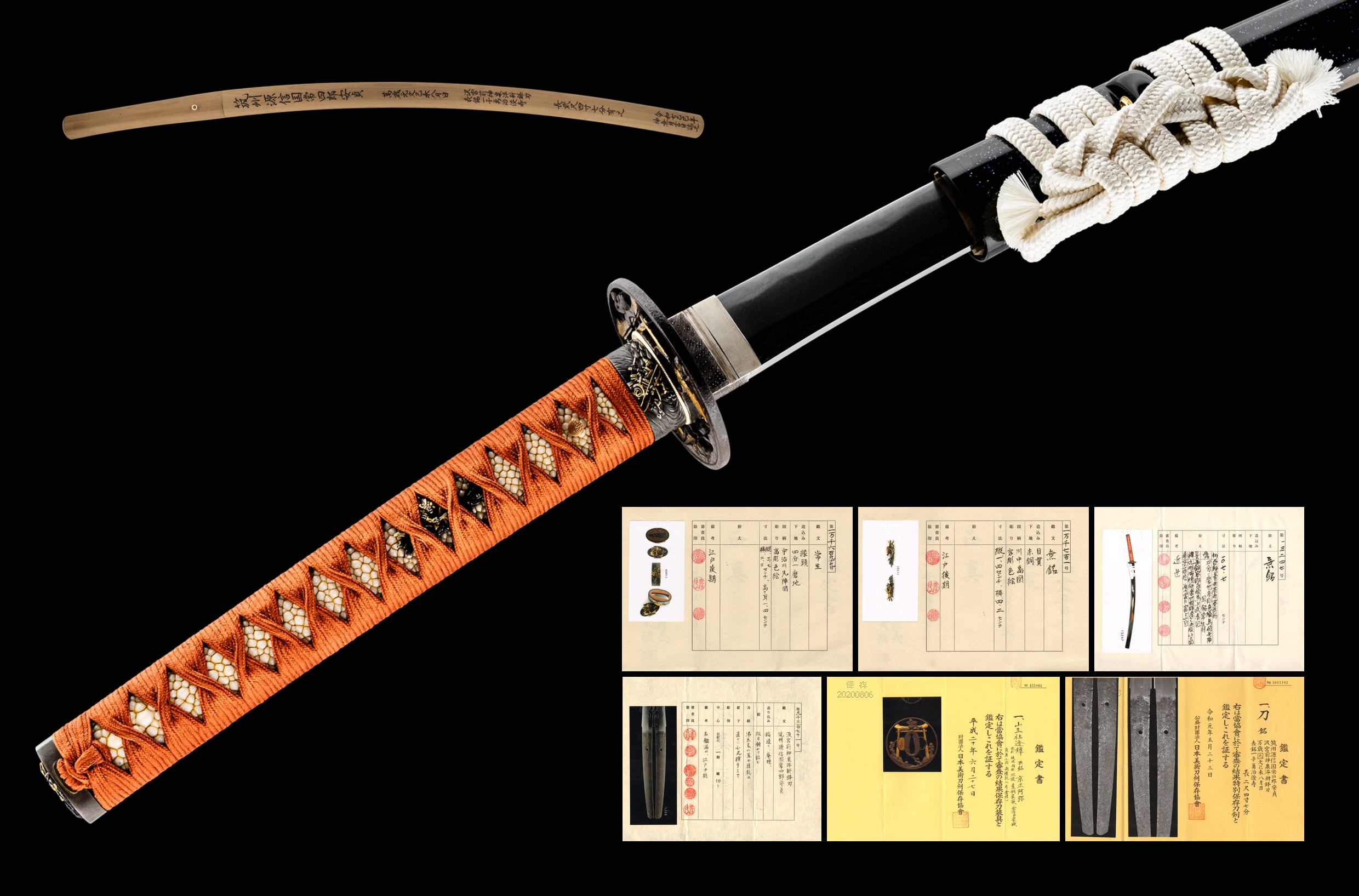
The Chikuzen Nobukuni school traces its origins to the Enbun era (1356-1361), when the lineage relocated to Chikuzen Province in Keichô 7 (1602) and entered the service of the Kuroda clan. Under that patronage the school produced a succession of accomplished smiths – among them Yoshimasa and Yoshikane – and became one of the defining swordmaking traditions of northern Kyûshû. The smith who signed this blade as Yasusada does not appear under that name in standard swordsmith directories, making him an exceptionally rare figure. Research points strongly to an identification with the Chikuzen Nobukuni smith Yasutoshi (安俊), who used the personal name Tsuneshirô – a detail that corresponds exactly with the signature on this blade – and who is recorded as having died in Hôreki 1 (1751). The date inscribed here, Genbun era, August 1739, falls comfortably within that working life. It is likely that Yasusada was either an early or retirement name used alongside the better-known Yasutoshi signature.
The blade itself is a statement piece. At 74.8 cm it exceeds one kilogram – an unusual combination of length and weight that suggests this was not a fighting sword but a symbolic commission, forged with sacred water in front of Sawa no Miya and dedicated to the smith’s son Yûji Toshihisa, as the lengthy nakago inscription records. The jihada is well-forged itame with nagare, and the hamon is a lively nie-dominant $1 with chôji elements, thick nie, tobiyaki, and active sunagashi – the overall impression evoking mountain ridgelines rising above a sea of clouds. The sword is accompanied by an NBTHK Tokubetsu Hozon certificate issued in Reiwa 1 (2019).
The koshirae was custom-built for this sword and carries a unified sacred theme throughout. The lacquered scabbard depicts Mount Fuji emerging from a sea of clouds beneath a star-filled sky reminiscent of nie crystals, with a vividly painted Shintô torii gate in the foreground. Echoing this motif, the hilt is wrapped in orange braids – the colour of vermilion, the colour of torii. The tsuba, certified NBTHK Hozon and attributed to the Kyô-Shôami school, depicts the Hiyoshi Shrine in distinctive iron openwork with gold inlay and sacred monkeys rendered in three dimensions. The fuchi-kashira, by Tsuneo of the Ishiguro school, depicts the legendary Race to Cross the Uji River from the Genpei War, while the menuki show the Battle of Kawanakajima – two of the most celebrated confrontations in samurai history, rendered with precision on a polished shibuichi ground.
| Item Number | UJKA324 |
| Sword Type | Katana |
| Swordsmith | Minamoto Nobukuni Tsuneshirô Yasusada (first generation) |
| Swordsmith (JP) | 源信国常四郎安貞 |
| Signature | Chikushû Minamoto Nobukuni Tsuneshirô Yasusada / Sawa no Miya mae shinsen arata na hôjin o niragu / Banzai Genbun tsuchinoto-hitsuji doshi hachigatsu hi / Omote mei Isshi Yûji Toshihisa |
| Date | Genbun era, Year of the Sheep, 8th month (August 1739) |
| School | Chikuzen Nobukuni |
| Province | Chikuzen |
| Period | Shintô · Edo period (Genbun era: 1736-1741) |
| Nagasa | 74.8cm |
| Sori | 2.8cm |
| Moto-haba | 3.25cm |
| Weight | 1,130g |
| Nakago | Ubu (original, unaltered tang) |
| Jihada | Well-forged itame with nagare |
| Hamon | Gunome-midare in nie-deki with chôji elements, tobiyaki, sunagashi and kinsuji |
| Boshi | Nie-deki, rounded |
| Certificates | NBTHK Tokubetsu Hozon (sword) · NBTHK Hozon (tsuba) · NTHK-NPO Kanteishô (koshirae, fuchi-kashira, sword and tsuba) |
| Sayagaki | Nozomi-san (shodô artist) – inscribed on a lucky day in the 10th month, Reiwa 7 (October 2025) |
| Koshirae | Custom uchigatana-koshirae (aogai-mijin-nuri taka-maki-e saya) depicting Mount Fuji, clouds, and a Shintô torii gate; modern period |
| Tsuba | Kyô-Shôami school (mumei) – iron openwork depicting the Sannô (Hiyoshi) Shrine with gold inlay and sacred monkeys; NBTHK Hozon |
| Fuchi-kashira | Tsuneo, Ishiguro school – shibuichi, high relief depicting the Race to Cross the Uji River (Ujigawa Senjin-zu) |
| Menuki | Ishiguro school – shibuichi, depicting the Battle of Kawanakajima (Takeda Shingen and Uesugi Kenshin) |
| Tsuka | White samekawa (ray-skin), wrapped hishimaki style in orange braids |
| Habaki | Silver habaki with copper ground |
| Catalogue | Catalogue 33 |
| Status | Sold |
| Includes | Shirasaya with sayagaki and tsunagi-gaki by Nozomi-san, custom koshirae, fabric bags, stand, kit, printed description |