
ITEM# UJKA265 – Sold
An Ayanokôji Katana (綾小路)
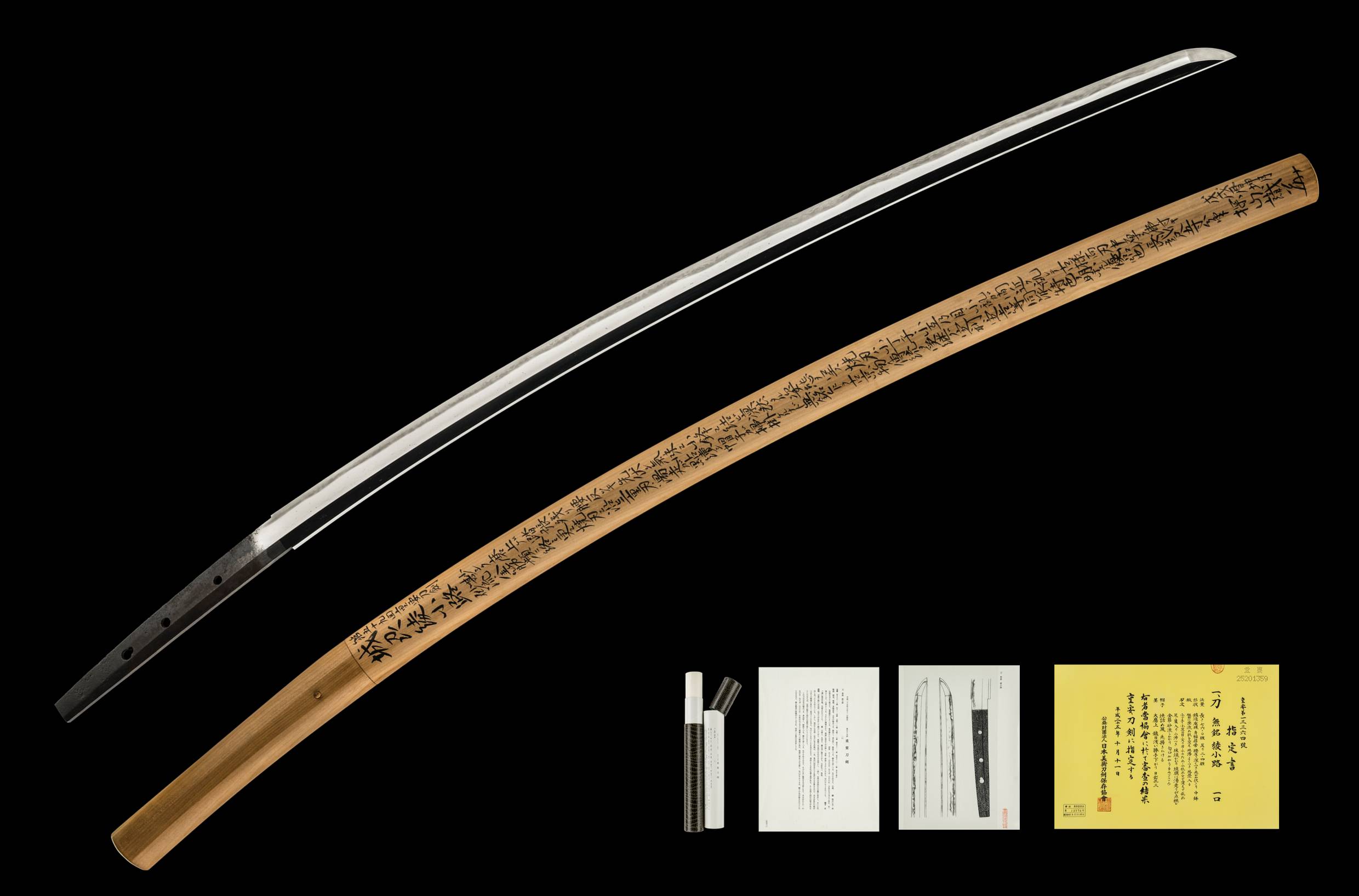
The Ayanokôji school worked in the Ayanokôji district of Kyôto, and its representative smiths – Sadatoshi (定利) and Sadayoshi (定吉) – were active around the Bun’ei era (1264-1275) in the mid-Kamakura period. Their work occupies a distinctive position in the Ko-Kyô-mono tradition: at first glance it recalls the refined elegance of Awataguchi Kuniyasu, yet the closely arranged small midare elements, tendency toward nijûba, and subdued nioiguchi point to a school that had been quietly forging in Yamashiro before the great Rai tradition was fully established. The NBTHK has noted that the late years of Sadatoshi likely overlapped with the early years of Rai Kuniyuki, and that the two smiths may have made daisaku works for one another – placing Ayanokôji blades at a fascinating crossroads of the early Kyôto schools.
This blade is a near-ubu tachi in all but name – its proportions are exceptional: long nagasa of 76.0cm, deep koshizori bending gently toward the tip, wide mihaba with a high shinogi, thick kasane, funbari, and a composed chû-kissaki. The ji-gane is a standing-out itame mixed with mokume and nagare, with fine ji-nie and fine chikei throughout. The hamon is a densely packed, ko-nie-laden mix of ko-chôji, ko-gunome, togariba, and ko-midare, with abundant muneyaki, disconnected yubashiri appearing above the yakigashira, plenty of kinsuji and sunagashi, and a characteristically subdued nioiguchi. The boshi runs out nearly as yakitsume with hakikake – precise, restrained, and entirely consistent with the school. Tanobe Michihiro, in his sayagaki, describes the overall effect as “awe-inspiring.”
The blade was submitted for Tokubetsu Jûyô consideration and came close to passing – a point conveyed to Unique Japan directly by a member of the shinsa committee, and a reflection of the esteem in which the piece is held. It holds NBTHK Jûyô Tôken certification from the 59th session (2013), and the shirasaya carries a sayagaki by Tanobe Michihiro (Tanzan-sensei), written in October 2018, which calls it a masterwork displaying the full traditional character of the Ko-Kyô-mono schools.
| Item Number | UJKA265 |
| Sword Type | Katana |
| Attribution | Ayanokôji (mumei) |
| School | Ayanokôji |
| Province | Yamashiro |
| Period | Kotô – Mid Kamakura period (Bun’ei era: 1264-1275) |
| Nagasa | 76.0cm (suriage) |
| Sori | 2.4cm |
| Moto-haba | 3.0cm |
| Nakago | Ô-suriage mumei, kirijiri, katte-sagari yasurime (slightly slanting), three mekugi-ana |
| Jihada | Standing-out itame mixed with mokume and nagare; fine ji-nie and fine chikei throughout |
| Hamon | Ko-nie-laden mix of ko-chôji, ko-gunome, togariba, and ko-midare; many ashi and yô; much muneyaki; disconnected yubashiri over yakigashira; plentiful kinsuji and sunagashi; subdued nioiguchi |
| Boshi | Sugu-chô running out yakitsume-like; hakikake at tip |
| Certificates | NBTHK Jûyô Tôken (59th session, 2013) |
| Sayagaki | Tanobe Michihiro (Tanzan-sensei) – Ayanokôji, Yamashiro province, 59th Jûyô Tôken; describes “sukoshiku suriage” (lightly shortened), awe-inspiring sugata; masterwork in the Ko-Kyô-mono tradition of Sadatoshi and Sadayoshi; dated Heisei 30, tenth month (October 2018) |
| Status | Sold |