
ITEM# UJDI007 – Catalogue 29 – Sold
A Toppei-Koshirae Daisho (突兵拵大小)
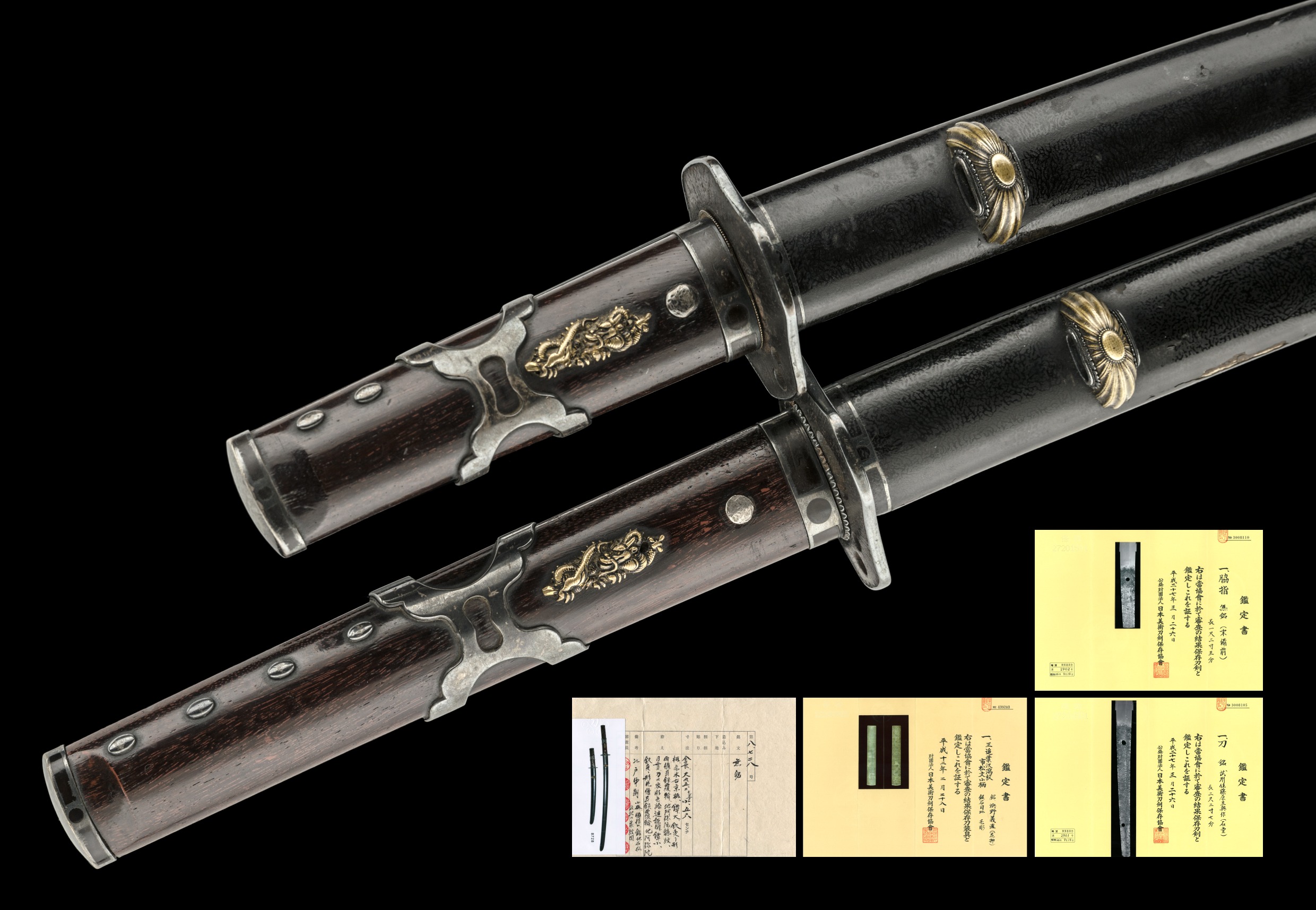
The toppei-koshirae (突兵拵) represents one of the most fascinating transitional moments in the history of Japanese arms. When Meiji-era Japan adopted French-influenced military dress, the introduction of wide danbukuro trousers demanded a new way of carrying the sword – suspended vertically in a leather frog from the belt. The scabbard butt tapered sharply to slip cleanly through the frog, and this distinctive tapering sayajiri reminded observers of a toppai-kabuto, a helmet with a tapered bowl, giving these fittings their name. Complete toppei-daisho – a matched pair – are genuinely rare survivals from this short-lived transitional era.
The dai (katana) was made by Mitsuoki of the Edo Ishido school, working in the Genroku era (circa 1688–1704) in the classic Bizen-revival tradition that the Ishido smiths inherited from the Kamakura Ichimonji lineage. The sho (wakizashi) is an actual Sue-Kotô Bizen piece from the late Muromachi period, crafted during Japan’s age of civil war and reminiscent of the work of Sukemitsu and Sukesada, with a bright koshibiraki-hamon. Both blades are in good polish and are noticeably light – a practical requirement for swords intended to hang from a leather frog rather than rest in a sash.
The koshirae itself rewards close study. The matching black-lacquered saya bear elegant silver en-suite inlay bands and kurigata (scabbard knobs) fashioned in the design of the Japanese rising sun flag – the Kyokujitsu-ki – strongly suggesting this daisho was carried by a member of the Imperial Japanese Navy. The redwood ukyo-tsuka (matching hilts) are finished with iron fuchi-kashira and gold dragon menuki, their vigour well-matched to the severity of the iron fittings. The tsuba of both swords are iron with Amida-yasurime file strokes radiating like the corona of an Amida Nyorai Buddha statue. The dai saya also houses a fine kozuka (utility knife) signed by Hamano Yoshinao with kao, depicting the three-arrowroot-leaves crest on a checkerboard ichimatsu pattern – itself holding an NBTHK Hozon certificate.
| Item Number | UJDI007 |
| Sword Type | Daisho (katana & wakizashi) |
| Dai (Katana) | |
| Swordsmith | Bushu-ju Fujiwara Mitsuoki |
| Swordsmith (JP) | 武州住藤原三奥作(石堂) |
| Signature | Bushu-ju Fujiwara Mitsuoki saku (Ishido) |
| School | Edo Ishido |
| Province | Musashi |
| Period | Shintô · Early Edo (Genroku era: 1688–1704) |
| Nagasa | 68.8cm |
| Sori | ~1.2cm |
| Moto-haba | 2.9cm |
| Weight | 601g |
| Nakago | 23.7cm, ubu, 2 mekugi-ana |
| Sho (Wakizashi) | |
| Attribution | Sue-Bizen school (mumei, o-suriage) |
| School | Sue-Bizen |
| Province | Bizen |
| Period | Sue-Kotô · Late Muromachi |
| Nagasa | 37.7cm |
| Sori | ~1.0cm |
| Moto-haba | 2.65cm |
| Weight | 327g |
| Nakago | 12.1cm, o-suriage, 1 mekugi-ana |
| Hamon | Koshibiraki-hamon (wakizashi) |
| Koshirae & Fittings | |
| Koshirae | Toppei-koshirae daisho – black lacquered saya with tapering sayajiri and silver en-suite inlay bands; rising-sun kurigata suggesting Imperial Navy provenance |
| Tsuba | Daisho set, iron with Amida-yasurime file strokes (radiating corona pattern); NBTHK Hozon |
| Menuki | Gold dragon menuki (daisho) |
| Tsuka | Ukyo-tsuka – matching hilts in redwood with iron fuchi-kashira; katate-maki wrapping style |
| Kozuka | Mitsu-tsuiha omodaka-mon ichimatsu-mon kozuka (一、三追葉沢潟市松文小柄); signed Hamano Yoshinao + kao; NBTHK Hozon |
| Certificates | |
| Certificates | NBTHK Hozon (katana), NBTHK Hozon (wakizashi), NBTHK Hozon (kozuka), NTHK-NPO Kanteisho (daisho koshirae) |
| Catalogue | Catalogue 29 |
| Status | Sold |
| Includes | Two shirasayas, daisho koshirae, fabric bags, stands, maintenance kit |