
ITEM# UJDI017 – Catalogue 47 – Sold
A Yoshikado & Michitoki Daishô (関善定兼吉家武蔵守吉門 ・ 若狭守藤原道辰)
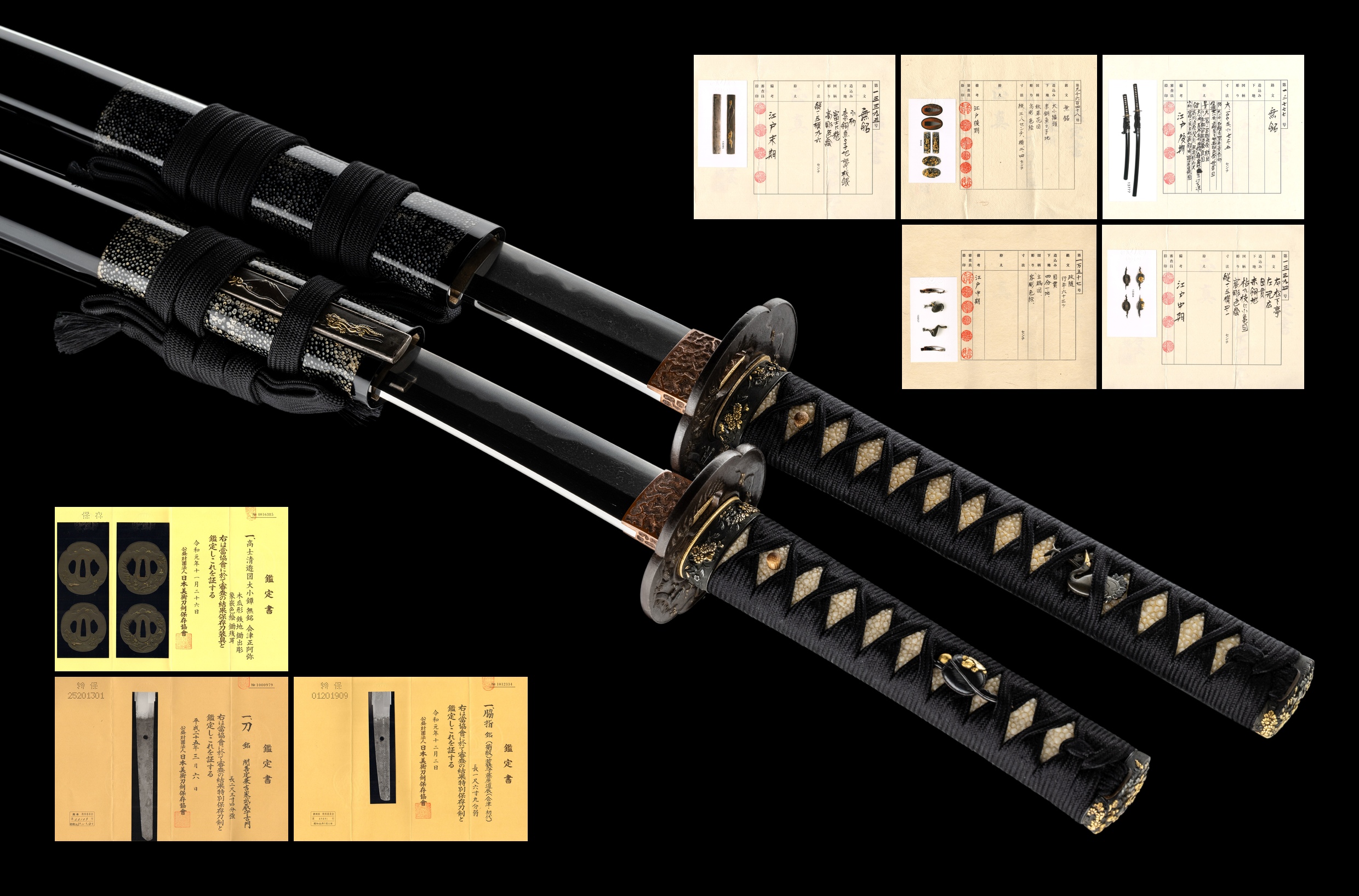
This daishô pairs a katana by Musashi no Kami Yoshikado with a wakizashi by Wakasa no Kami Michitoki, two smiths of different generations brought together in one magnificent union. Yoshikado was active in the Mito domain of Hitachi province from the Kan’ei era (1624-1644) through the Enpô era (1673-1681). Born in Mino, he proudly inscribed his Seki Zenjô Kaneyoshi lineage in his signature. He trained under Ômura Kaboku, a figure of unusual background who was both a physician and a swordsmith, and served as private retained smith to Tokugawa Mitsukuni, the second daimyô of Mito. Ranked jôsaku, with a cutting-sharpness rating of ryô-wazamono, Yoshikado signed this blade with the title Musashi no Kami, which dates it before Enpô 4 (1676), most likely to around the Kanbun era (1661-1673).
The katana measures 71.0cm with deep sori, a pronounced taper from moto-haba to saki-haba and a chû-kissaki. The jihada is a fine, tight ko-itame with itame near the monouchi and standing-out utsuri, while the chôji-midare hamon, with thick nie, bright nioiguchi and sunagashi, produces a strikingly brilliant effect. Yahazuba and pointed togari appear along the hamon, and tobiyaki scatter through the ji. Michitoki, who flourished around the Shôtoku era (1711-1716), trained under the first-generation Miyoshi Nagamichi and later under the third-generation Iga no Kami Kinmichi, holder of the title Nihon Kaji Sôshô, Grand Master of Japanese Smiths. After receiving the title Wakasa no Kami he was permitted, alongside Kinmichi, to carve a chrysanthemum crest into the nakago, which suggests he may have produced blades for the imperial court. His wakizashi shows a ko-itame jihada through which masame flows, and a bright gunome-midare hamon with long ashi, thick nie and sunagashi. Two parallel lines of kinsuji appear in one area, which is quite rare.
A wonderful custom daishô koshirae, produced by Unique Japan, is unified throughout in black. Its most distinctive feature is the togidashi-zame, polished ray-skin, that wraps the lower portion of each saya with quiet elegance, matched by copper ganseki habaki with a rock-textured finish. The paired iron daishô tsuba is by the Aizu Shôami school and depicts noble scholars at leisure. The fuchi-kashira, from the Môgarashi school of Hikone, shows autumn grasses and flowers in gold and colour accents on a shakudô nanako ground. A crane menuki by Hamano Shôzui on the katana and a tortoise menuki by Matsushitatei Motohiro on the wakizashi pair longevity symbols from two leading metalworkers, and the kozuka by Akagiken Motonaga shows a dragon rising above Mount Fuji. A daishô worthy of the name.
| Item Number | UJDI017 |
| Sword Type | Daishô (katana & wakizashi) |
| Swordsmith | Shodai Yoshikado (katana) & Shodai Michitoki (wakizashi) |
| Swordsmith (JP) | 関善定兼吉家武蔵守吉門 (katana) ・ 若狭守藤原道辰 (wakizashi) |
| Signature | Seki Zenjô Kaneyoshi-ke Musashi no Kami Yoshikado – katana / (Kikumon) Wakasa no Kami Fujiwara Michitoki – wakizashi |
| School | Seki Zenjô (Yoshikado) / Aizu (Michitoki) |
| Province | Hitachi (Yoshikado) / Iwashiro, Aizu (Michitoki) |
| Period | Shintô – Edo period (Kanbun era: 1661-1673 & Hôei era: 1704-1711) |
| Nagasa | Katana: 71.0cm (ubu) / Wakizashi: 51.3cm (ubu) |
| Sori | Katana: 1.8cm / Wakizashi: 1.3cm |
| Moto-haba | Katana: 3.18cm / Wakizashi: 2.9cm |
| Weight | Katana: 760g / Wakizashi: 540g |
| Nakago | Ubu, ha-agari kurijiri, one mekugi-ana each; katana 21.4cm with takanoha-yasurime, wakizashi 14.8cm with katte-sagari-yasurime and kikumon |
| Jihada | Well-forged itame and nagare-hada with plentiful chikei; utsuri on the katana |
| Hamon | Gunome-midare with bright nioiguchi, kinsuji, yô, yahazuba, sunagashi and long ashi |
| Certificates | NBTHK Tokubetsu Hozon (katana, Heisei 25, March 6, 2013); NBTHK Tokubetsu Hozon (wakizashi, Reiwa 1, December 2, 2019); NBTHK Hozon (daishô tsuba, Reiwa 1, November 26, 2019); NTHK-NPO Kanteishô (fuchi-kashira, kozuka, koshirae and 2 x menuki) |
| Fujishiro Rank | Jô-saku (Yoshikado) |
| Sharpness Rating | Ryô-wazamono (Yoshikado) / Wazamono (Michitoki) |
| Sayagaki | Nozomi-san (shodo artist) – Yoshikado around Kanbun and Michitoki around Shôtoku forming a daishô, inscribed in the 5th month, Reiwa 8 (May 2026) |
| Koshirae | Custom daishô-uchigatana-koshirae by Unique Japan, black lacquer saya with lower third in polished ray-skin (togidashi-zame); kozuka by Akagiken Motonaga with Mount Fuji and dragon, shibuichi with silver-plated reverse |
| Tsuba | Iron, Aizu Shôami, matched daishô pair (mumei) depicting noble scholars at leisure |
| Fuchi-kashira | Môgarashi school, shakudô nanako with gold and colour accents, autumn grasses and flowers |
| Menuki | Crane by Hamano Shôzui (katana) and tortoise by Matsushitatei Motohiro (wakizashi) |
| Tsuka | White samegawa wrapped in black ito, hishi-maki style |
| Habaki | Copper ganseki (rock-texture) habaki, matching for both swords |
| Catalogue | Catalogue 47 |
| Status | Sold |
| Includes | Shirasaya x 2, tsunagi x 2, daishô koshirae, fabric bags, kit, printed description |