
ITEM# UJKA484 – Catalogue 47 – Sold
A Sandai Yasutsugu Katana (康継以南蛮鉄於武州江戸作之)
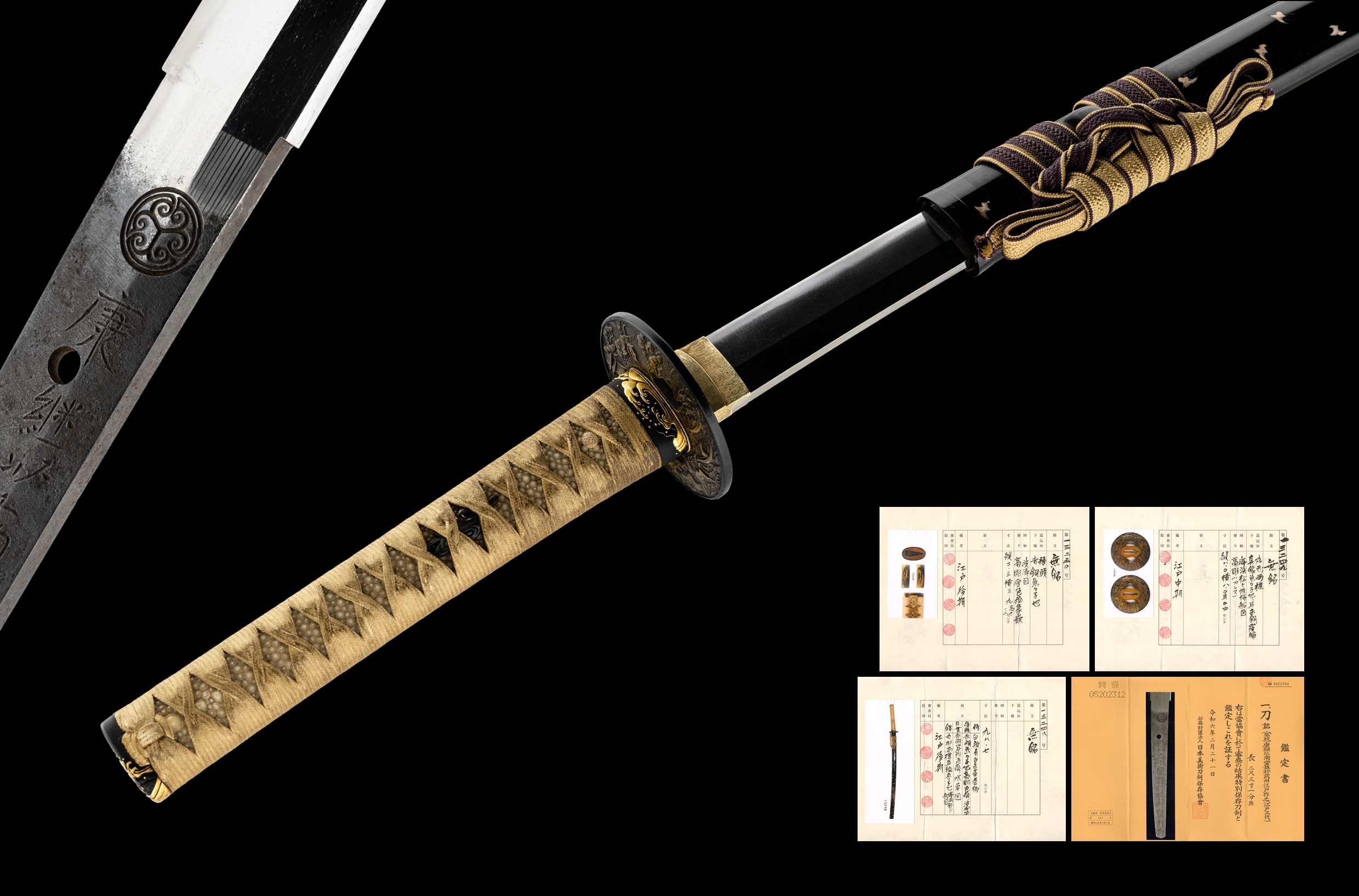
Few smiths in Japanese history carried the weight of official recognition that the Yasutsugu line did. Founded in the late Sengoku period and elevated to the position of official swordsmith to the Tokugawa shogunate, the school inherited two extraordinary privileges from the founder: the character 康 (Yasu) drawn from Tokugawa Ieyasu’s own name, and the right to stamp the aoi-mon – the hollyhock crest of the ruling Tokugawa family – directly onto the nakago. Both marks appear prominently on this blade. After Nidai Yasutsugu died in 1646 the line divided into Edo and Echizen branches; the Edo house held the senior position, working directly in the capital at the heart of shogunal power. This is a blade from that senior lineage, forged by the third generation during the Kanbun era.
The mei proudly announces that the blade was forged using Nanban-tetsu – foreign-sourced iron imported through the southern trade networks running through Kyûshû, most likely from northern Thailand, China, or Indian Wootz traded onward through the Dutch East India Company. Metallurgical analysis of such blades confirms that the imported steel was used strategically, concentrated toward the cutting edge rather than distributed throughout. By the mid-17th century the bakufu had moved to formally restrict its use, yet the Yasutsugu school’s position within the Tokugawa orbit meant they remained among the very few lines still authorised to work with it. The Nanban-tetsu declaration in the mei is therefore a statement of privilege as much as a technical note. The jihada is beautifully worked – fine itame and rounded mokume-hada that swirls like whirlpools across the steel, alive with shining ji-nie and plentiful chikei. Tilt the blade to the right angle and a bright shirake-utsuri – the hamon’s reflection within the dark jigane – comes into view. The hamon is a bright chû-suguha with gentle notare undulation, uchinoke crescent-moon formations, niju-ba doubling, generous sunagashi, and particularly impressive kinsuji channels visible even at the yokote area – the PDF notes this is fairly rare to see. A thick, snowy-white nioiguchi lines the hamon throughout. The boshi runs straight then turns back in a neat ko-maru kaeri extending onto the mune. A substantial sword at 790g, weighty and confident in the hand.
The Late Edo koshirae is nothing short of spectacular. The saya is finished in glossy black roiro lacquer decorated in gold maki-e with waves and chidori birds – each bird individually inlaid in awabi abalone shell. Nami-chidori: waves and birds. One of the most beloved motifs in Japanese art, the imagery carries layers of meaning – the waves represent the hardships of life, the birds are family flying together above them, and there is wordplay too, as chidori echoes chidoru, meaning to seize a thousand, quietly carrying prayers for victory and the attainment of goals. The fuchi-kashira is attributed to Ômori Teruhide (大森英秀, 1730-1798), the adopted son of Ômori Hidemasa and second-generation head of the celebrated Ômori school, which itself studied under the legendary Yokoya Sômin – the man who effectively defined the aesthetic vocabulary of Edo-period metalwork. The groundwork is top-quality shakudô nanako with raised gold Ômori-nami waves, rich, deep, and wholly alive. The tsuba is a brass sanmai-awase construction depicting pine trees on the shore and a sailing boat crossing open water – safe voyages, prosperity, the open seas ahead. Creativity and resourcefulness in equal measure. The tsuka is wrapped in ivory-coloured ito aged beautifully over white samegawa, and the menuki are shakudô with gold accents carrying an aquatic plant motif – a considered companion to the waves rolling across the fuchi-kashira. The koshirae, the tsuba, and the fuchi-kashira each carry their own NTHK-NPO Kanteishô certificate of authenticity. One further note of distinction: the original torokusho registration card from Shôwa 26 (1951) survives with the sword. It was registered in Ôsaka under registration number 567 – from the very first year swords were formally registered in Japan, suggesting this blade was once held by a prominent daimyô family who chose to register rather than surrender it. It never left Japan. A katana of exceptional character, superb scholarly interest, and outstanding koshirae, ready to shine in a serious collection.
| Item Number | UJKA484 |
| Sword Type | Katana |
| Swordsmith | Sandai Yasutsugu (Edo branch, third generation) |
| Swordsmith (JP) | 康継以南蛮鉄於武州江戸作之 |
| Signature | (Aoi-mon) Yasutsugu Nanban-tetsu o motte Bushû Edo ni oite kore o tsukuru (Edo Sandai) |
| School | Edo Yasutsugu |
| Province | Musashi (Edo) |
| Period | Shintô – Early Edo period (Kanbun era: 1661-1673) |
| Nagasa | 70.1cm |
| Sori | 0.9cm |
| Moto-haba | 3.02cm |
| Weight | 790g |
| Nakago | Ubu, katte-sagari-yasurime, iriyama-gata, 1 mekugi-ana; Tokugawa aoi-mon (hollyhock crest) stamped on omote |
| Jihada | Mokume and itame with dark jigane, ji-nie and plentiful chikei; shirake-utsuri visible |
| Hamon | Bright chû-suguha with notare, uchinoke, niju-ba, sunagashi, ko-ashi and kinsuji; thick nioiguchi throughout |
| Boshi | Ko-maru kaeri, extends onto the mune |
| Certificates | NBTHK Tokubetsu Hozon (Reiwa 6, 2024); NTHK-NPO Kanteishô x3 (koshirae, fuchi-kashira, tsuba) |
| Fujishiro Rank | Jô-saku |
| Koshirae | Late Edo period (1780-1868) uchigatana-koshirae; black roiro-nuri saya with gold maki-e nami-chidori and abalone-inlaid plover birds |
| Tsuba | Brass, sanmai-awase construction; pine shore and sailing boats design; NTHK-NPO Kanteishô certified |
| Fuchi-kashira | Attributed to Ômori Teruhide (大森英秀, 1730-1798); shakudô nanako with gold Ômori-nami waves; NTHK-NPO Kanteishô certified |
| Menuki | Shakudô with gold accents; aquatic plants motif |
| Tsuka | White samegawa beneath ivory-coloured aged ito |
| Habaki | Gold nijû-habaki with copper ground |
| Video | Watch Pablo’s video presentation on YouTube |
| Catalogue | Catalogue 47 |
| Status | Sold |
| Includes | Shirasaya, Edo-period koshirae, NBTHK Tokubetsu Hozon certificate, NTHK-NPO Kanteishô certificates (x3), original torokusho registration card (Shôwa 26, 1951), fabric bags, cleaning kit, printed description |