
ITEM# UJWA265 – Sold
A Shodai Masahiro ‘3-Body Tameshigiri’ Wakizashi (肥前国河内大掾藤原正廣)
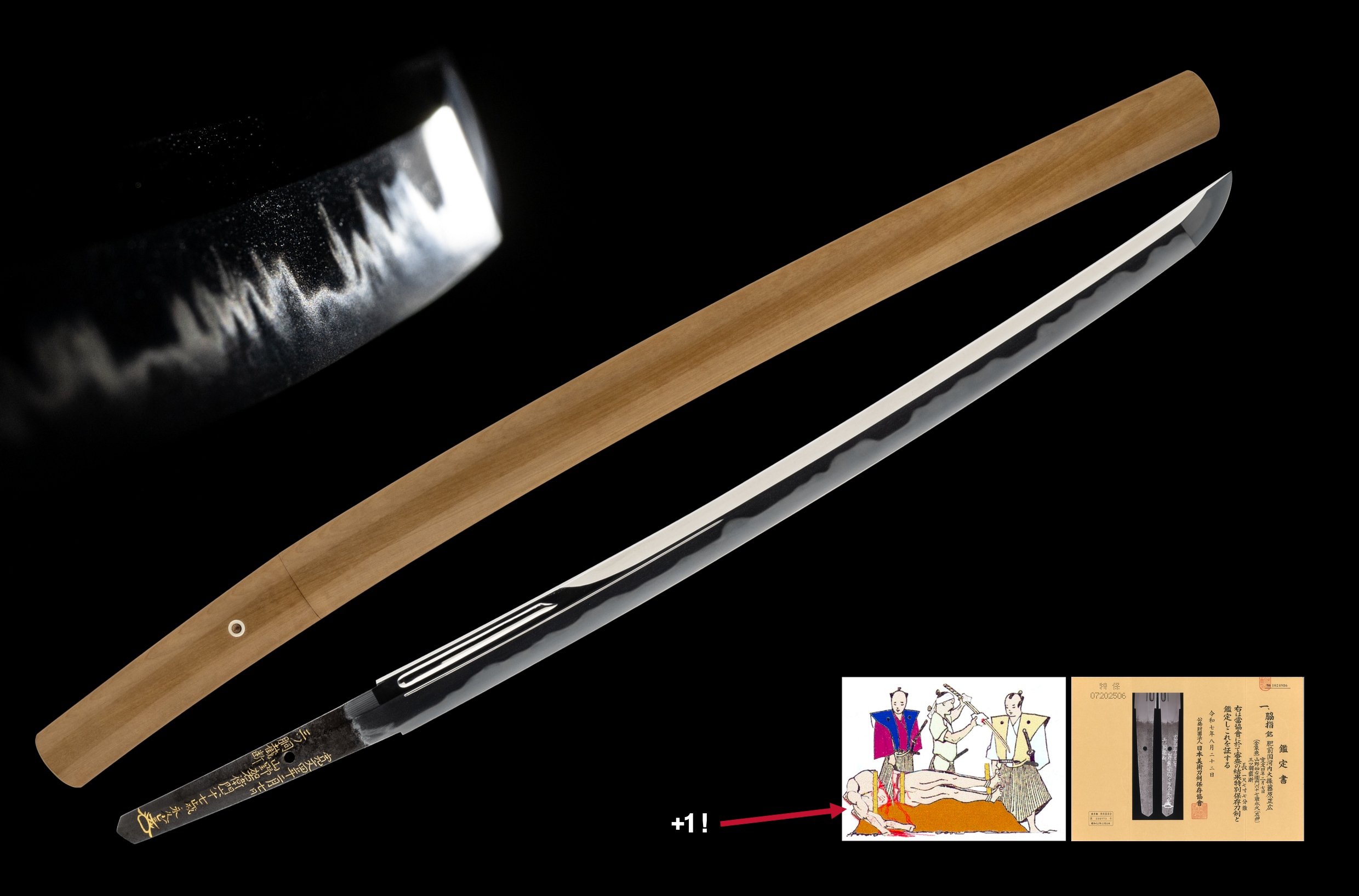
There are Hizen blades, and then there are Hizen blades that make you stop. Kawachi Daijô Masahiro – shodai, first generation – was the grandson of the grandmaster Shodai Tadayoshi, founder of the entire Hizen tradition, and he carried that lineage with extraordinary distinction. Originally signing as Masanaga, it was the daimyô of Saga domain himself, Nabeshima Katsushige, who in 1625 – when Masahiro was just nineteen – personally ordered him to change his name. The Nabeshima clan held him in such high regard that historical records suggest they favoured him even above the main Tadayoshi line, regularly calling on him to serve as mentor and substitute smith. His rankings of jô-saku and wazamonô were not honorary titles. This blade explains why.
What sets this long wakizashi apart from the very first glance is its construction. A naginata-hi groove runs along the base, and just above it the blade tapers at the back-ridge into an extremely rare unokubi-zukuri configuration – named after the cormorant’s neck, a shape the PDF notes has never previously been seen on a Masahiro blade. It speaks directly to a special commission. The jihada is the finest tightly forged Hizen konuka-hada, alive with ji-nie and a light utsuri drifting through the steel. The hamon is a wide-ranging, energetic gunome-midare laden with choji, thick nie, brilliant kinsuji and sweeping sunagashi. The nioguchi is impressively wide – it nearly reaches the shinogi. A textbook display of what jô-saku means in practice.
And then there is the nakago. A kinzôgan gold-inlay inscription records a cutting test performed on February 7th, 1664 – Kanbun 4 – by Yamano Ka’emon no Jô Nagahisa, the founding figure of professional tameshigiri in the Edo period, at the age of 67. In a single stroke, he severed three bodies. On a wakizashi, that is a remarkable result, and a three-body test is genuinely rare. The PDF research reveals that this was the first in a remarkable series of three-body tests Nagahisa performed throughout 1664 – all on blades by the greatest smiths of the age – and it was Shodai Masahiro who opened the year. Nagahisa himself had three years left to live. Masahiro had just one. Two masters, both in their final chapters, and the proof is here in gold. The blade comes in shirasaya with a gold habaki on a copper ground, and is a prime candidate for a custom koshirae – and for Tanzan-sensei sayagaki, should his schedule permit.
| Item Number | UJWA265 |
| Sword Type | Wakizashi |
| Swordsmith | Shodai Masahiro (Kawachi Daijô Fujiwara Masahiro, first generation) |
| Swordsmith (JP) | 肥前国河内大掾藤原正廣 |
| Signature | Hizen no Kuni Kawachi Daijô Fujiwara Masahiro |
| School | Hizen |
| Province | Hizen |
| Period | Shintô – Early Edo period (Kan’ei era: 1624-1644) |
| Nagasa | 53.7cm (ubu) – Note: cover sheet states 53.6cm; NBTHK certificate states 53.7cm – certificate figure used |
| Sori | 0.9cm |
| Moto-haba | 3.07cm |
| Weight | 595g |
| Nakago | Ubu, sujikai-yasurime, kengyô (sword-shape) nakago-jiri, 1 mekugi-ana |
| Jihada | Ko-itame tending to Hizen konuka-hada, thick nie-deki, utsuri, ji-nie |
| Hamon | Wide gunome-midare with choji, kinsuji, sunagashi, long ashi, thick nie |
| Boshi | Ko-maru |
| Certificates | NBTHK Tokubetsu Hozon (issued Reiwa 7, August 22, 2025) |
| Fujishiro Rank | Jô-saku (a superior swordsmith) |
| Sharpness Rating | Wazamonô (rated as a maker of sharp swords) |
| Tameshigiri (JP) | (金象嵌)寛文四年二月七日山野加右衛門六十七歳永久(花押)三ツ胴截断 |
| Habaki | Gold habaki with copper ground |
| Video | Watch Pablo’s video presentation on YouTube |
| Status | Sold |
| Includes | Shirasaya, cleaning kit, booklet, printed description |
The PDF contains full photography, detailed blade analysis, and all certification documentation.