
ITEM# UJKA178 – Sold
A Masamitsu Katana (備州長船政光)
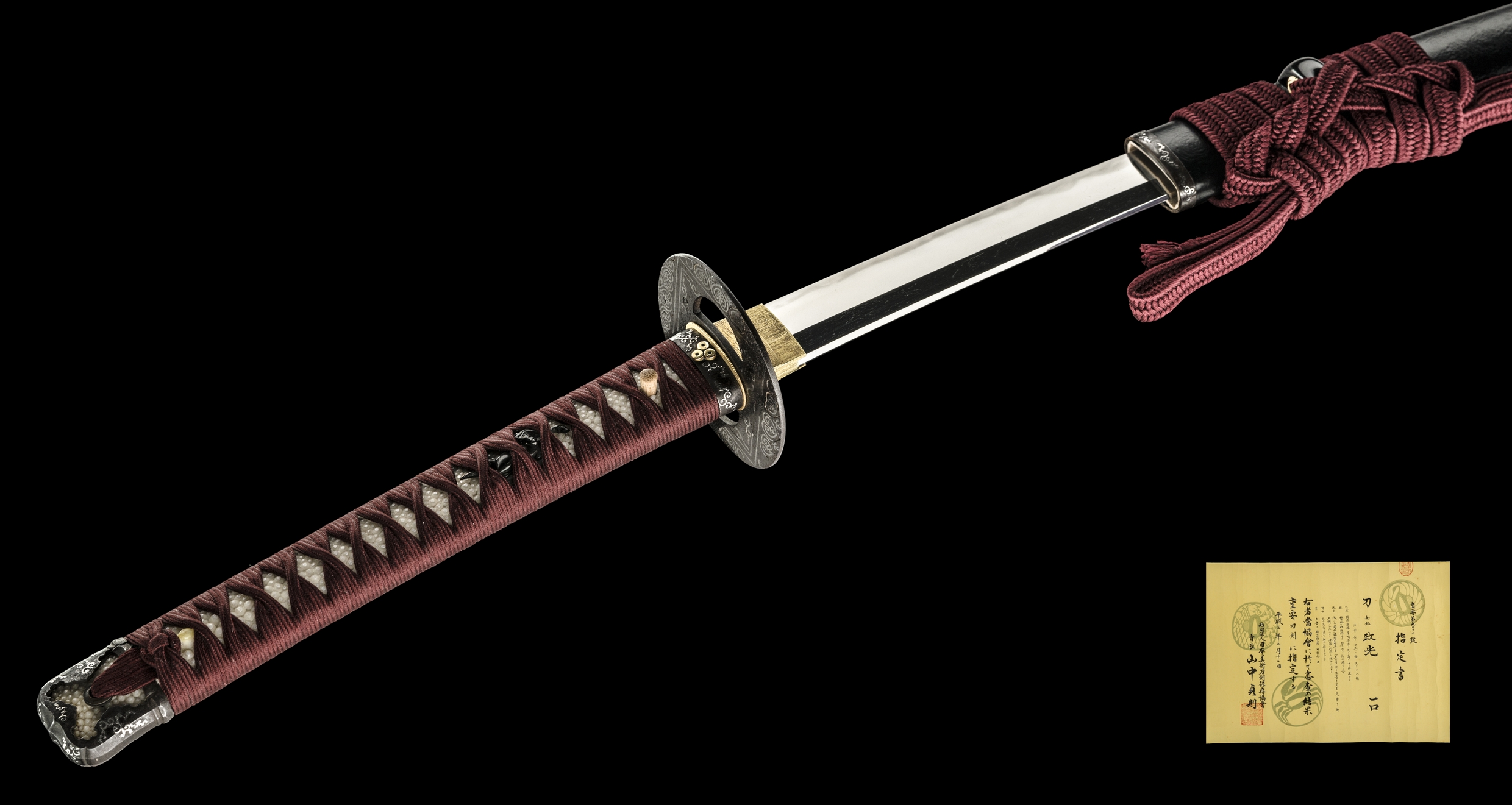
Masamitsu was a Bishû Osafune smith working through the latter half of the Nambokuchô period, the Enbun to Eiwa eras (1356-1379), in a line that ran straight back through his sensei Osafune Kanemitsu to the first generation of the great Osafune tradition. His work hews close to Kanemitsu’s; the discerning eye that separates the two notes that Masamitsu’s hamon runs a touch darker, his nioi-guchi a touch quieter. That family resemblance led the great early-20th-century scholar Hon’ami Koson, writing on the shirasaya, to attribute this very blade to Kanemitsu himself. The NBTHK, in due course, settled it on the student.
This katana began life as a tachi. The 75.1cm cutting edge, the 2.8cm of curvature and the long chûkissaki place it firmly in the Nambokuchô – the era of imperial schism and protracted civil war, a moment when samurai needed long blades to fight from horseback. The nakago was later shortened o-suriage to convert the tachi to the katana mounting style that came to dominate the Edo period, and in doing so lost its original signature. What remains in the blade is unmistakeable: a tight itame and mokume hada laced with chikei and midare utsuri, the swirling wood-grain spirals of Osafune at its finest; a shallow ko-notare hamon set with koshibiraki gunome, ko-gunome, togari-ba, ashi, kinsen and sunagashi; a midare-komi boshi pointing back with hakikake. A few kirikomi – small cutting marks along the body – speak to the blade’s service in combat. They are prized, not polished out.
In honour of the tachi heritage, a complete handachi koshirae – the ‘half-tachi’ hybrid that allowed a former tachi to be worn in the manner of a katana – was commissioned, the better part of 2016 spent assembling it. All fittings are from Higo province. The iron tsuba, papered NBTHK Hozon and attributed to the Nakane group of late-Edo Higo specialists, carries the sugimori-hôen design: silver-inlaid rectangles framing stylised cedar trees. The menuki, papered NBTHK Hozon to the Mito School, nod to the sword’s mounted-warrior origin. The saya is finished in a unique lacquer technique whose swirling pools recall the raked white gravel of a zen garden. The whole carries NTHK-NPO Kanteishô certification as an authentic handachi mounting. A profound blade, in a setting that honours every part of what it once was.
| Item Number | UJKA178 |
| Sword Type | Katana (former tachi, o-suriage) |
| Attribution | Attributed to Bishû Osafune Masamitsu (mumei) |
| Province | Bishû (modern-day Okayama) |
| Period | Kotô – Late Nambokuchô period (Enbun to Eiwa eras: 1356-1379) |
| Nagasa | 75.1cm |
| Sori | 2.8cm |
| Moto-haba | 3.1cm |
| Saki-haba | 2.2cm |
| Moto-kasane | 5.8mm |
| Saki-kasane | 4.7mm |
| Kissaki Nagasa | 3.5cm |
| Weight | 670g |
| Nakago | O-suriage, mumei, kurijiri tip, katte sagari yasurime, 2 mekugi-ana (nakago length 18.5cm) |
| Jihada | Tight itame and mokume hada with o-hada wood-grain spirals, ji-nie, chikei and midare utsuri |
| Hamon | Shallow ko-notare with koshibiraki gunome, ko-gunome, togari-ba, ashi, ko-nie, kinsen and sunagashi |
| Boshi | Midare-komi, togari (pointed), curling back finely with hakikake |
| Certificates | NBTHK Jûyô Tôken (37th session, 12 September 1991); NBTHK Hozon Tôken (tsuba); NBTHK Hozon Tôken (menuki); NTHK-NPO Kanteishô (koshirae) |
| Sayagaki | Hon’ami Koson (1879-1955) – attributed to Bizen no Kuni Osafune Kanemitsu, signed with kaô |
| Koshirae | Authentic handachi koshirae – all fittings from Higo province, assembled 2016, certified NTHK-NPO Kanteishô. Saya finished in unique zen-garden style swirling lacquer |
| Tsuba | Iron tsuba with sugimori-hôen design (rectangles framing stylised cedar trees in silver inlay), attributed to the Nakane group of Higo (late Edo, early 1800s), NBTHK Hozon |
| Menuki | Attributed to the Mito School, NBTHK Hozon |
| Status | Sold |
| Includes | Shirasaya with Hon’ami Koson sayagaki, silk sword bag, original NBTHK Jûyô Tôken certificate with white-paper oshigata, NBTHK Hozon certificates for tsuba and menuki, NTHK-NPO Kanteishô for koshirae |