
ITEM# UJKA158 – Sold
A Niô Tachi (二王)
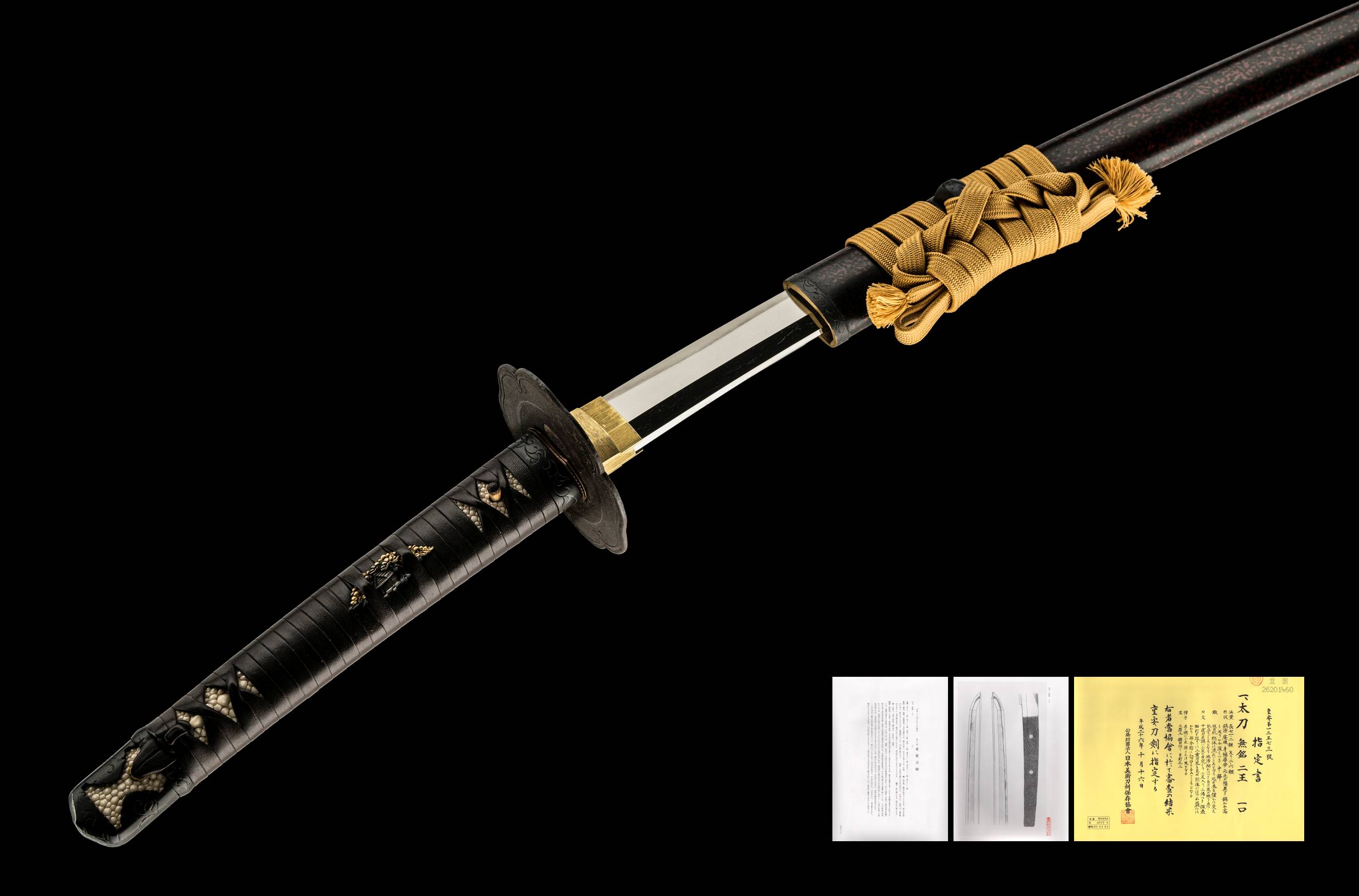
The Niô School (二王) of Suô province (present-day Yamaguchi prefecture) draws its roots from the Yamato tradition, and its origins are traced to the smith Kiyotsuna, whose earliest known signed work – a tachi preserved at Itsukushima Shrine – is dated Bunei 2 (1265). A tanto by the same hand dated Kenmu 2 (1336) attests to a long active period, and the school continued through many generations, sharing the Niô name from the Muromachi period into the Shintô era. What distinguishes Niô work from other Yamato-tradition schools is a visual signature all its own: a characteristic shirake utsuri in the ji, and a hamon with a distinctly moist, almost luminous quality at the nioiguchi – elements that give Niô blades an atmospheric, meditative presence quite unlike the harder, drier appearance of most Yamato work.
This tachi exemplifies those qualities in full measure. The sugata is that of an elegant, deeply curved blade – sori of 2.6 cm, standard mihaba, high shinogi, and a composed chû-kissaki – carrying the confident proportions of a sword made for use. The kitae is an itame with nagare, a little mokume, fine ji-nie throughout, and the characteristic shirake utsuri gently diffused across the ji. The hamon is a naka-suguha with ko-gunome, ko-ashi, and ko-nie, displaying a double-edged nijûba at the monouchi, lively hotsure along the ha, and the school’s distinctive watery, urumi nioiguchi. The bôshi is sugu-chô with a ko-maru-kaeri and fine hakikake. Both ji and ha are in healthy condition.
Unique Japan commissioned a custom handachi koshirae for this sword – a mounting style that honours the tachi form while allowing for comfortable wear. The tsuka is finished in black ito hishi-maki over white same-gawa with diamond windows, and set with a pair of gold menuki depicting a flower basket. The iron tsuba is of lobed mokko-gata form with subtle scroll ornament around the rim and an aged dark patina. The saya is lacquered in a deep, lustrous dark tone with a gold sageo that provides a warm counterpoint to the overall scheme.
| Item Number | UJKA158 |
| Sword Type | Tachi |
| Attribution | Niô (mumei) |
| School | Niô |
| Province | Suô |
| Period | Kotô – Nanbokuchô period |
| Nagasa | 71.2 cm |
| Sori | 2.6 cm |
| Moto-haba | 3.0 cm |
| Nakago | Ô-suriage, shallow kurijiri, kiri yasurime, two mekugi-ana, mumei |
| Jihada | Itame mixed with nagare and small mokume; fine ji-nie; shirake utsuri |
| Hamon | Naka-suguha with ko-gunome, ko-ashi, ko-nie; nijûba at monouchi; hotsure throughout; watery, urumi nioiguchi |
| Bôshi | Sugu-chô with ko-maru-kaeri and hakikake |
| Certificates | NBTHK Jûyô Tôken (60th session, October 16, 2014) – No. 13573 |
| Koshirae | Custom handachi mounting by Unique Japan |
| Tsuba | Iron, lobed mokko-gata form; subtle scroll ornament on rim; aged dark patina |
| Menuki | Gold, flower basket motif |
| Tsuka | Black ito hishi-maki over white same-gawa with diamond windows |
| Status | Sold |