
ITEM# UJKA398 – Sold
A Kanenaga Katana (兼長)
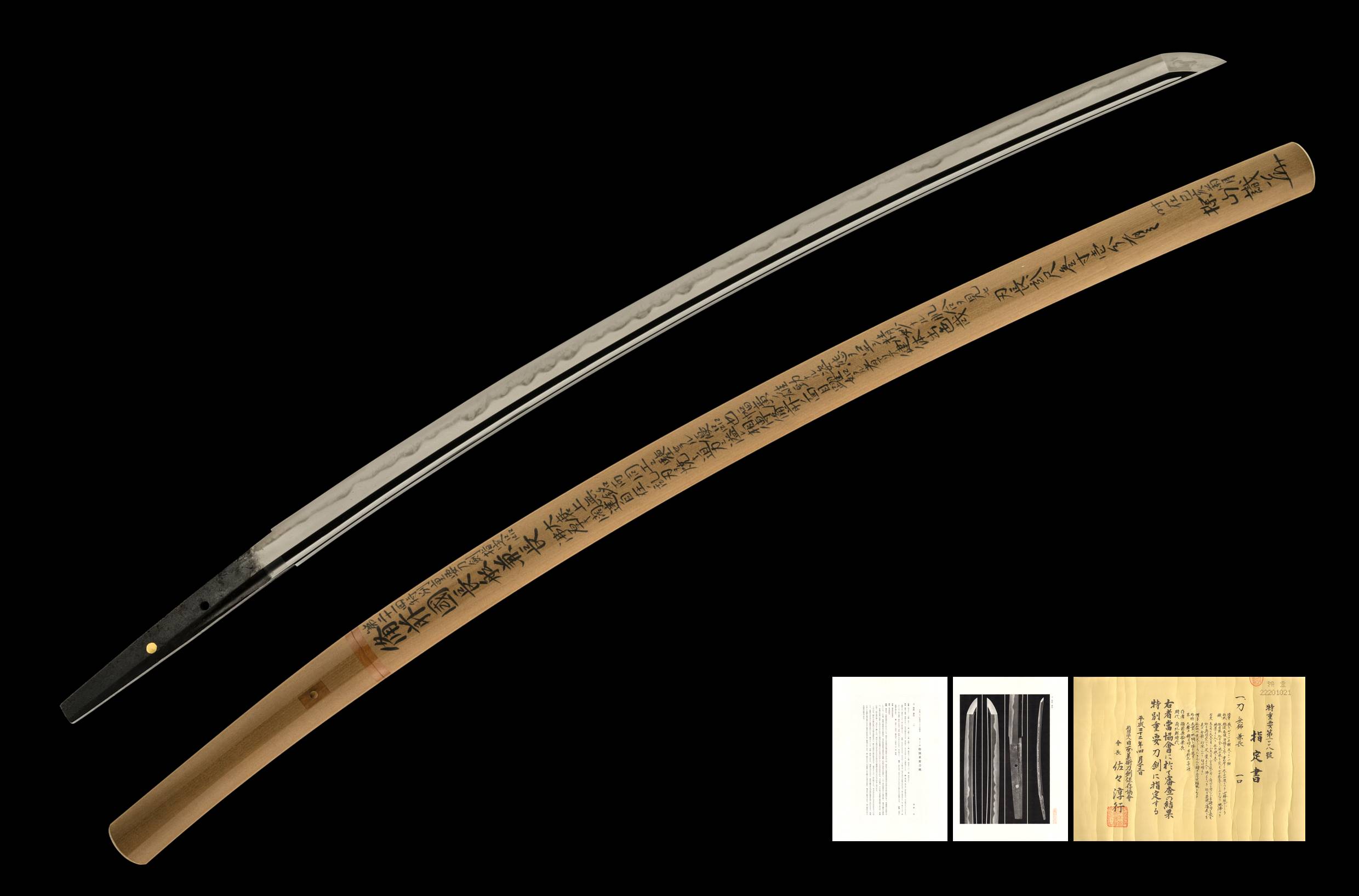
Osafune Kanenaga – whose name can also be read Kenchô – worked in the mid-to-late Nanbokuchô period as a student of the great Chôgi, master of the Sôden-Bizen approach. Signed works are among the rarest in the entire tradition: a wakizashi dated Jôji 5 (1366), designated Jûyô-Bijutsuhin, and two tanto dated 1387 and 1388 represent virtually the entirety of his known signed output. Long swords are almost invariably ô-suriage and mumei, identified by period attribution. It is in these katana that Kanenaga’s individual voice is most clearly heard – a hamon more emphatically nie-laden and bold than his master’s, drawing more decisively on the Sôshû tradition while remaining unmistakably rooted in Bizen.
This blade carries the commanding shape of the Nanbokuchô period in full measure: wide mihaba, thick kasane, a relatively deep sori, and a somewhat elongated chû-kissaki. The kitae is a standing-out itame partially mixed with mokume, rich in ji-nie and much chikei, with a faint midare-utsuri moving through the ji. The hamon is a nie-laden gunome with a bright nioiguchi packed with variety – ô-gunome, ko-gunome, chôji elements, angular sections, shimaba in places, and an abundance of ashi, yô, tobiyaki, yubashiri, kinsuji, and sunagashi throughout. The bôshi is midare-komi with a pointed kaeri heavy with hakikake, tending to kaen – a powerful and characteristic finish. Both ji and ha are perfectly healthy (kenzen). A bôhi is engraved on both sides, running as kaki-nagashi into the tang.
Of the 83 Kanenaga blades to have passed Jûyô, only nine katana have achieved the Tokubetsu-Jûyô designation – making each one exceptionally rare. This is one of them, and it belongs to the most aesthetically prized subset within that group: blades in which Chôgi-like refinement meets a bolder, more emphatically nie-laden execution, widely regarded as the pinnacle of Kanenaga’s known body of work in both quality and aesthetic appeal. The sayagaki by Tanobe Michihiro (Tanzan-sensei), inscribed in September 2019, confirms the attribution with characteristic authority, praising the wide and commanding shape, the exquisite forging structure, the bold and vivid midareba, and the exemplary state of preservation.
| Item Number | UJKA398 |
| Sword Type | Katana |
| Attribution | Attributed to Kanenaga (mumei) |
| School | Osafune (Chôgi School / Sôden-Bizen) |
| Province | Bizen |
| Period | Nanbokuchô period |
| Nagasa | 70.15 cm |
| Sori | 2.1 cm |
| Moto-haba | 3.0 cm |
| Nakago | Ô-suriage, kirijiri, kiri-yasurime, two mekugi-ana (one plugged), mumei |
| Jihada | Standing-out itame partially mixed with mokume; ji-nie, much chikei, faint midare-utsuri |
| Hamon | Nie-laden gunome with bright nioiguchi; mixed with ô-gunome, ko-gunome, chôji and angular elements, shimaba; many ashi and yô, tobiyaki, yubashiri, kinsuji and sunagashi throughout |
| Bôshi | Midare-komi with pointed kaeri, heavy hakikake, tending to kaen |
| Certificates | NBTHK Tokubetsu Jûyô Tôken (21st session, April 23, 2010) |
| Sayagaki | Tanobe Michihiro (Tanzan-sensei) — Osafune Kanenaga, attributed, September 2019 (year of the boar) |
| Status | Sold |