
ITEM# UJKA299 – Sold
A Kunihiro Katana (堀川国広)
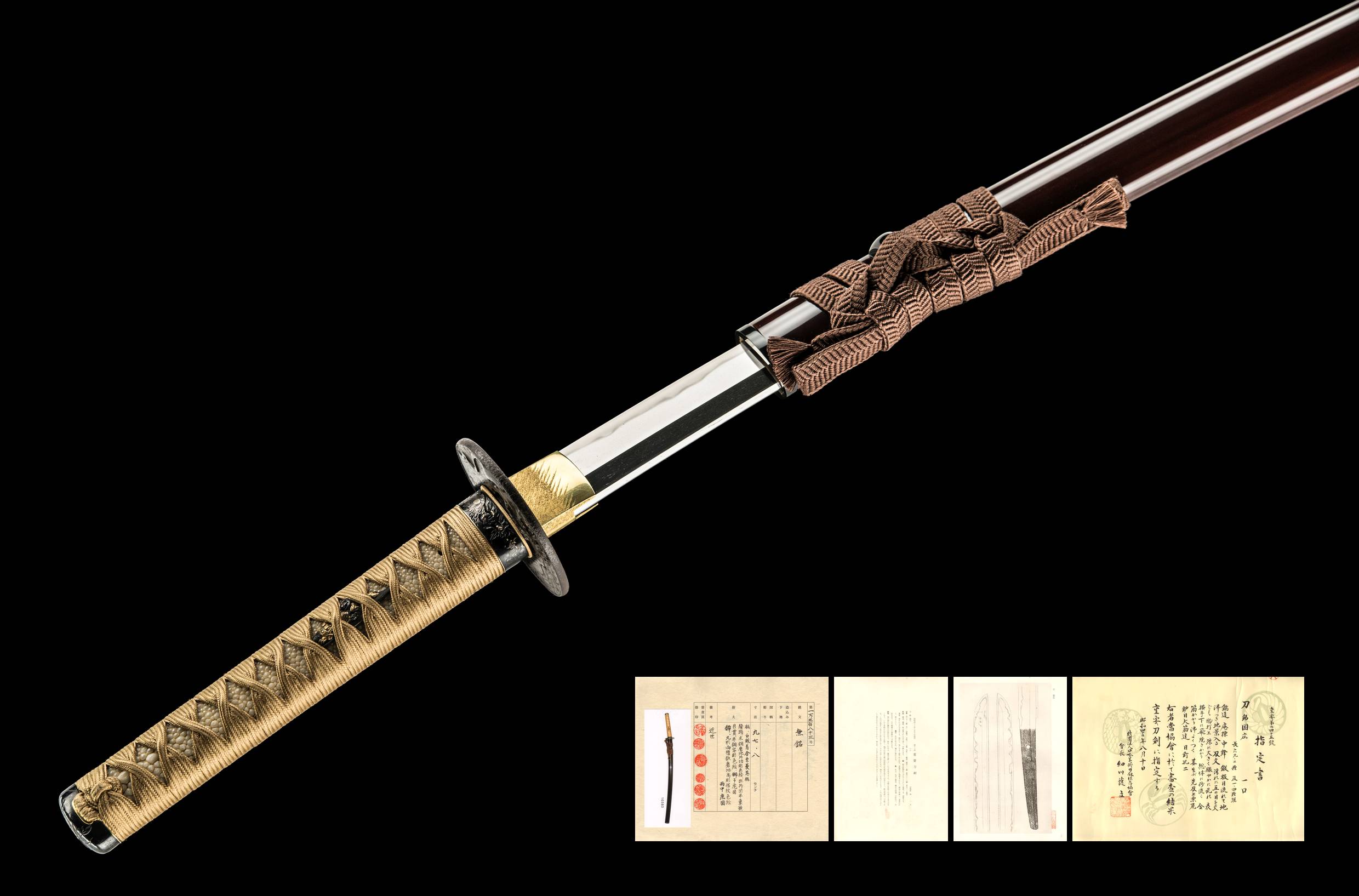
Horikawa Kunihiro is the founding figure of the Horikawa school and one of the most important smiths of the early Shintô period. Born in Obi in Hyûga province on Kyûshû, he lived through the turmoil of the Sengoku era before eventually making his way to Kyôto. There he studied under the celebrated metalworker Umetada Myôju, and after forging a sword for Emperor Ôgimachi received the honorary title of Shinano no Kami. He established his forge in the Horikawa district of the capital, roughly two kilometres south of Nishijin, and worked there until his death in 1614 at the age of 84. His school – which counted Izumi no Kami Kunisada and Kawachi no Kami Kunisuke among its leading students – shaped the entire early Edo tradition of Yamashiro swordsmanship. More than any other Shintô smith, Kunihiro looked to the great Kotô masters for inspiration, and the Shizu-utsushi in particular became his signature form: wide mihaba, shallow sori, a large kissaki evoking the silhouette of a shortened Nanbokuchô blade.
The NBTHK dates this blade to around Keichô 9 (1604), at the heart of Kunihiro’s mature period in Kyôto. The sugata reads exactly as described: wide mihaba, not much taper, shallow sori, and a composed chû-kissaki that carries the feeling of an ancient blade without pretending to be one. The jihada is an itame-nagare that appears in the characteristic zanguri manner of the Horikawa school, with ji-nie and chikei throughout. The hamon is a nie-laden notare mixed with gunome, sunagashi and kinsuji distributed freely across the entire blade, the ha growing wider and more vivid toward the monouchi with tobiyaki appearing on the omote below the yokote. The ubu-nakago bears the niji-mei (国広) in the characteristic hand – characters somewhat narrow at the top, widening toward the bottom. The placement of the mekugi-ana is a known feature of Kunihiro’s nakago: he habitually placed the original hole at a low position, and a second was opened later, with the original subsequently plugged.
Two sayagaki accompany this blade, spanning nearly half a century of scholarly opinion. Kashima Isao wrote the first in December 1956, noting that the sugata and the jiba are reminiscent of Shizu Saburô Kaneuji – the very kotô master Kunihiro spent his career in pursuit of. Tanobe Michihiro (Tanzan-sensei) wrote the second in November 2003, calling it a typical Shizu copy masterwork of this smith, with magnificent deki, that “shall surely be treated as precious rarity.” The sword is mounted in a brilliant custom koshirae by Unique Japan: a vermilion lacquered saya with gradation (aka-urumi-nuri), a gold-braided hishi-maki tsuka over white ray skin, shakudô fuchikashira with peony design in katakiribori and flat inlay, shakudô menuki depicting a lion and tiger in iroe, and a round iron tsuba in high relief showing a tiger in the rain with colour accents and a set-in motif. The koshirae holds NTHK-NPO certification (2019).
| Item Number | UJKA299 |
| Sword Type | Katana |
| Swordsmith | Horikawa Kunihiro |
| Swordsmith (JP) | 堀川国広 |
| Signature | Kunihiro – niji-mei, characters widening toward bottom |
| School | Horikawa |
| Province | Yamashiro |
| Period | Shintô – Early Edo period (Keichô era: 1596-1615; dated c.1604 by NBTHK) |
| Nagasa | 69.2cm |
| Sori | 1.4cm |
| Moto-haba | 3.15cm |
| Nakago | Ubu, ha-agari kurijiri, ô-sujikai yasurime, two mekugi-ana (one original, plugged; one later) |
| Jihada | Itame-nagare in zanguri manner; ji-nie and chikei |
| Hamon | Nie-laden notare mixed with gunome; sunagashi and kinsuji throughout; ha widens and becomes more vivid along monouchi; tobiyaki on omote below yokote |
| Boshi | Midare-komi with ko-maru-kaeri and a few hakikake |
| Certificates | NBTHK Jûyô Tôken (16th session, 1967); NTHK-NPO Certificate of Designation – koshirae (No. 10383, 2019) |
| Sayagaki (1) | Kashima Isao – notes sugata and jiba reminiscent of Shizu Saburô Kaneuji; partial text; dated Shôwa 31, twelfth month (December 1956) |
| Sayagaki (2) | Tanobe Michihiro (Tanzan-sensei) – Horikawa Kunihiro from Ichijô, Yamashiro; ubu-nakago with niji-mei; “typical Shizu copy masterwork of this smith but also of a magnificent deki – shall thus surely be treated as precious rarity”; dated Heisei 15, eleventh month (November 2003) |
| Koshirae | Aka-urumi-nuri saya uchigatana-koshirae; vermilion lacquer with gradation; brilliant custom mounting by Unique Japan; NTHK-NPO certified authentic (No. 10383, 2019) |
| Tsuba | Iron, round shape (marugata), polished ground; high-relief tiger in the rain (uchû tora no zu) with colour accents and set-in motif; two hitsu-ana |
| Fuchi-kashira | Shakudô, polished ground (migaki-ji), katakiribori, iroe, flat inlay (hira-zôgan); peony (botan) design |
| Menuki | Shakudô, katachibori, iroe; lion and tiger (shishi tora) design |
| Tsuka | White ray skin (shirozame); gold braided ito (kin-ito), hishi-maki wrapping |
| Status | Sold |