
ITEM# UJKA253 – Sold
A Tsuda Sukehiro Katana (津田越前守助広)
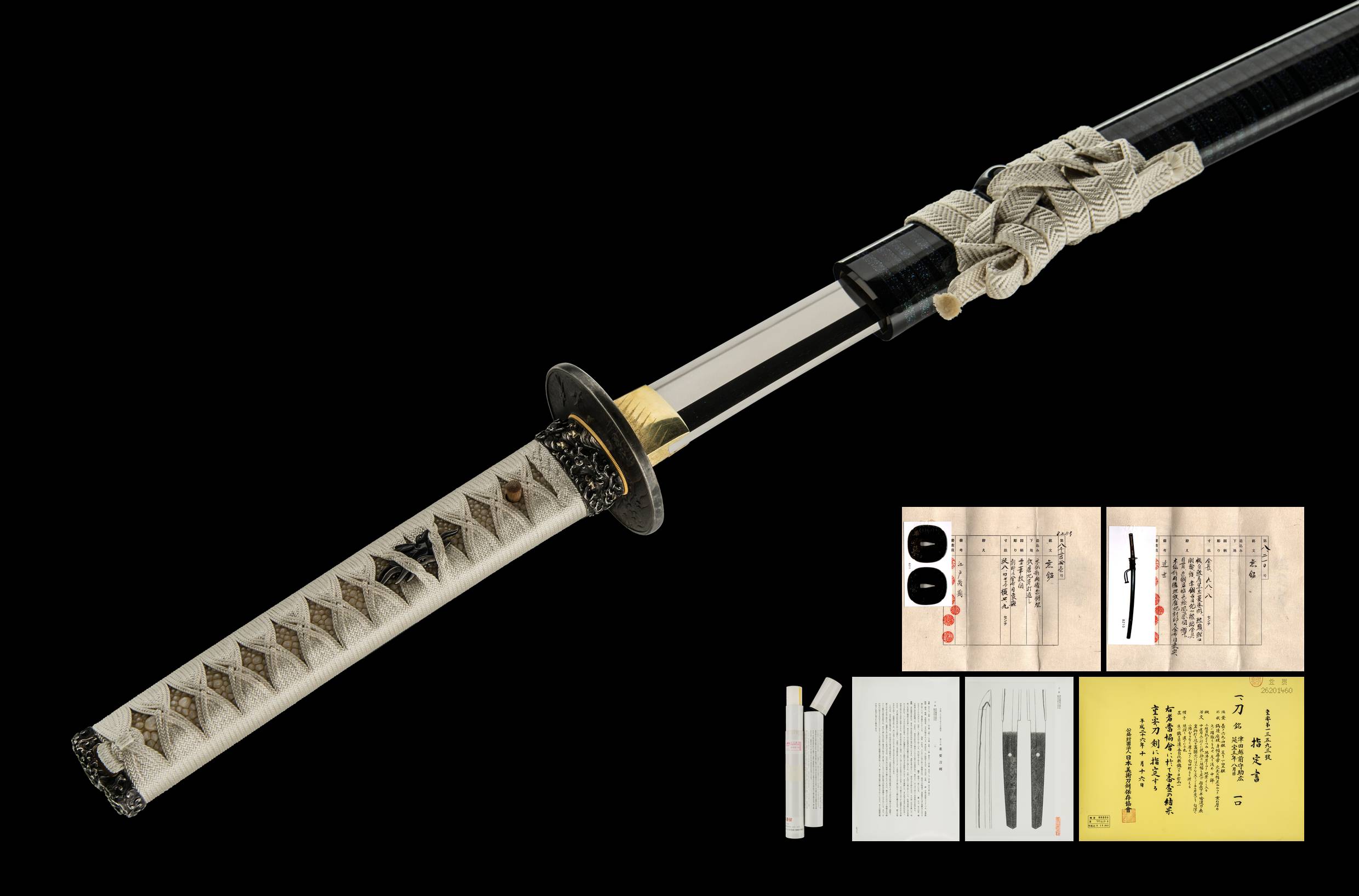
Tsuda Echizen no Kami Sukehiro (1637-1682) is one of the towering figures of Ôsaka Shintô. Born in the village of Uchide in Settsu province – present-day Ashiya – he studied under Soboro Sukehiro before becoming the second generation. He received the honorary title of Echizen no Kami around 1657 and was later employed by Aoyama Inaba no Kami Munetoshi, castellan of Ôsaka, from 1667. His career evolved through three distinct phases: an early chôji-midare reminiscent of the Ishidô school, a middle period of gunome-midare, and finally the celebrated tôran-midare – a wave-like hamon of his own invention that became one of the most sought-after hamon forms of the Edo period. He also hardened an extraordinarily refined suguha, and alongside Inoue Shinkai is regarded as one of the two supreme masters of suguha from Ôsaka. He died in 1682 at just 46 years of age.
This katana – signed in seven characters on the omote with a date inscription of the eighth month of Enpô 5 (1677) on the ura – represents the suguha aspect of Sukehiro’s genius at its fullest. The sugata is a classic Kanbun-shintô form: noticeably tapered, shallow sori, thick kasane, funbari at the base, and a composed chû-kissaki. The kitae is precisely what defines Ôsaka-shintô: an exceptionally dense and uniformly forged ko-itame with no irregularities, flooded with fine ji-nie and finely interwoven chikei, producing the brilliant, glassy surface quality the school is known for. The hamon is a ko-nie-laden chû-suguha whose wide nioiguchi broadens gradually toward the yokote – bright and clear throughout – with subtle kuichigai-ba along the lower sashi-omote and small togari elements at the monouchi. The widely hardened boshi turns back with a rounded ko-maru-kaeri. The nakago is ubu with the distinctive kôzutsumi-style keshô yasurime. This blade is recorded in the Shintô Taikan, page 419. Tanobe Michihiro, in his sayagaki, calls it a work of excellent deki with a very healthy jiba – “a work that should be valued highly.”
The sword is mounted in a custom koshirae built around a wave theme of exceptional quality. The centrepiece is an iron mokko-gata tsuba attributed to the Den Edo Gotô Ichijô school: polished iron ground with carved seal engraving and gold cloth inlay depicting crashing waves – dramatic and sculptural. The saya is finished in black ishimeji (pebble stone) lacquer; the fuchi, kashira, koiguchi, dôwa, and kojiri form a matching shakudô ishimeji set; the menuki are shakudô with kin-iroe phoenix motifs. The koshirae and the tsuba separately hold NTHK-NPO Certificates of Designation, both issued 2017. The mounting was certified authentic on the same date as a unified ensemble.
| Item Number | UJKA253 |
| Sword Type | Katana |
| Swordsmith | Tsuda Echizen no Kami Sukehiro (second generation) |
| Swordsmith (JP) | 津田越前守助広 |
| Signature | Tsuda Echizen no Kami Sukehiro – naga-mei (seven characters), sashi-omote |
| Date | Enpô gonen hachigatsu hi (Enpô 5, eighth month, 1677) – ura, cursive script |
| School | Ôsaka Shintô |
| Province | Settsu |
| Period | Shintô – Early Edo period (Enpô era: 1673-1681) |
| Nagasa | 69.4cm |
| Sori | 1.45cm |
| Moto-haba | 2.95cm |
| Nakago | Ubu, iriyamagata-jiri, sujikai-yasurime with kôzutsumi keshô, one mekugi-ana |
| Jihada | Overall very dense ko-itame; plentiful ji-nie and much fine chikei |
| Hamon | Ko-nie-laden chû-suguha; wide bright nioiguchi widening toward tip; kuichigai-ba along lower sashi-omote; small togari elements at monouchi on both sides; ko-nie very evenly distributed |
| Boshi | Widely hardened sugu with ko-maru-kaeri |
| Certificates | NBTHK Jûyô Tôken (60th session, 2014); NTHK-NPO Certificate of Designation – koshirae (No. 8210, 2017); NTHK-NPO Certificate of Designation – tsuba (No. 8211, 2017) |
| Sayagaki | Tanobe Michihiro (Tanzan-sensei Hendô) – seven-character mei dated Enpô 5 (1677); praises the suguha as showing the smith’s finest qualities alongside the tôranba; “a work that should be valued highly” (chinchô shikarubeki kana); dated Heisei 26, third month (March 2014) |
| Koshirae | Kuro ishimeji nuri saya uchigatana-koshirae; wave-themed custom mounting; NTHK-NPO certified authentic (No. 8210, 2017) |
| Tsuba | Mokko-gata, polished iron; carved seal engraving with gold cloth inlay; crashing wave design; Den Edo Gotô Ichijô school; late Edo period; NTHK-NPO certified (No. 8211, 2017) |
| Fuchi-kashira | Shakudô, ishimeji ground; matching set with koiguchi, dôwa, and kojiri |
| Menuki | Shakudô, katachibori, kin-iroe; phoenix (hôou) design |
| Tsuka | White ray skin (shira same); black silk ito (kuro ito), hishi-maki wrapping |
| Status | Sold |