
ITEM# UJKA404 – Catalogue 41 – Sold
A Munetsugu Tameshigiri Katana (於東都固山宗次作之)
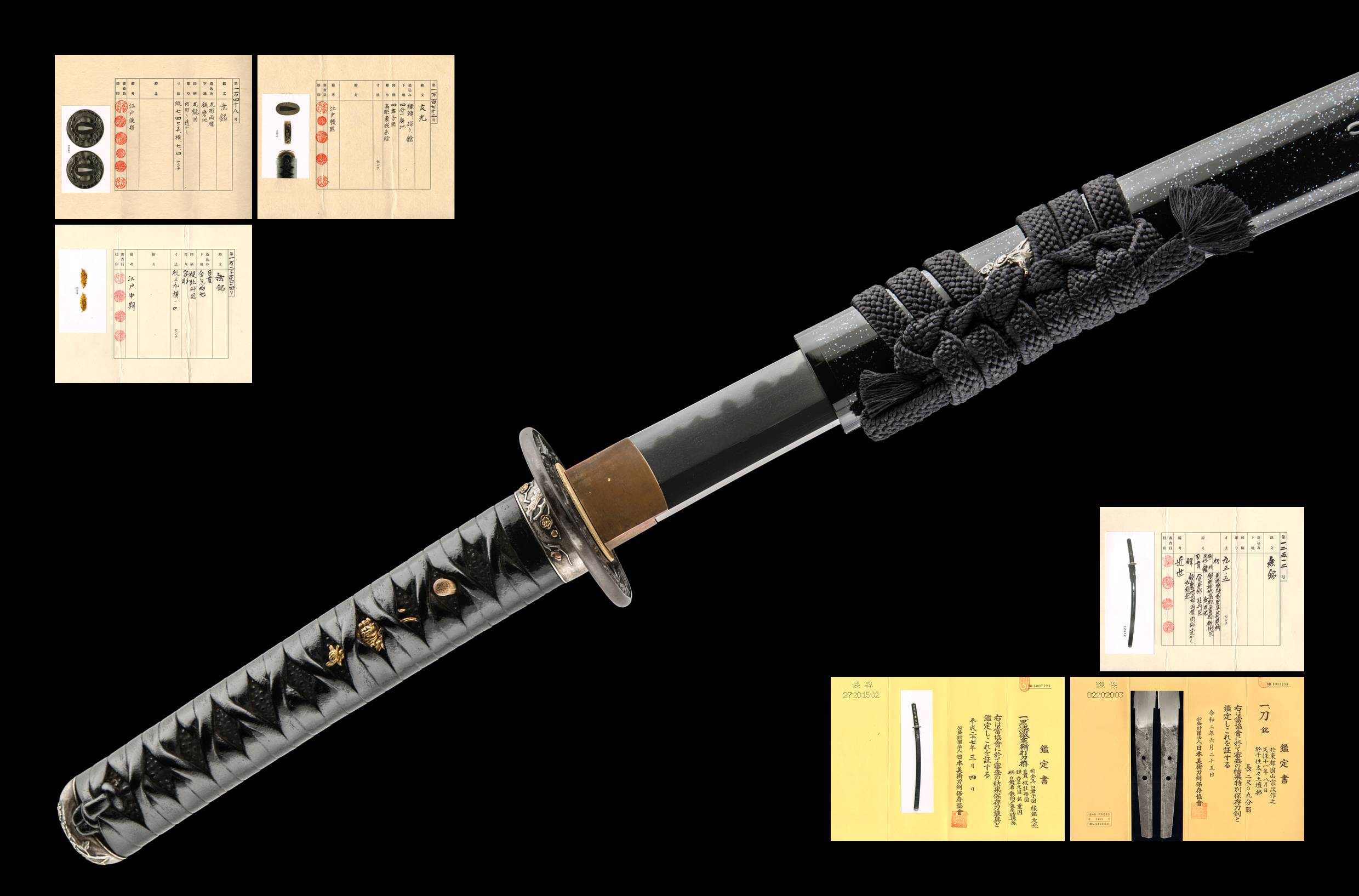
Crafted in Edo (modern-day Tokyo) in August 1841, this formidable katana is the work of Koyama Munetsugu, one of the great maestros of the shinshintô period. Fujishiro ranks him as jôjô-saku – a highly superior swordsmith – and this blade demonstrates exactly why. Born in the castle town of Shirakawa in Mutsu Province, Munetsugu served Lord Matsudaira Sadanobu before eventually settling in Edo as a retainer of the ruling clan of Ise, with Koto Tsunahide believed to have been his teacher there. He is best known for his Bizen-style chôji hamon in nioi-deki and finely forged mokume-hada, though here he works in a flowing nagare-hada – a beautiful, wavy grain that ripples across the polished surface. The gunome chôji-midare hamon dances with tremendous energy along the full length of the blade, punctuated by lines of kinsuji cutting through with conviction, and tobiyaki tempering marks leaping across the body. The boshi is a dramatic kaen – flames burning like a candle through the tip.
At 63.3cm, this thick, robust katana was inspired by the one-handed katate-uchi swords of the late Muromachi period, evoking the practical lethality of the Sengoku civil war era. Munetsugu had a well-documented relationship with the sword tester Yamada Asaemon, and the nakago of this blade bears chiselled proof of their connection: a tameshigiri cutting test recording that the sword severed cleanly through the chest of a convicted criminal below the armpits and into the earthen mound at the notorious Senju execution ground – a site responsible for some 200,000 executions between 1651 and 1873. The test is dated the 8th month of Tenpô 11 (August 1840), a year before the blade’s completion date, suggesting the cutting test inscription commemorates an earlier trial.
The sword comes with a complete custom uchigatana-koshirae produced in Japan, lacquered in lustrous black with fine particles of mother-of-pearl that sparkle like a night sky. The fittings were sourced from an antique koshirae signed by Tomomitsu of the Hitotsuyanagi school and certified by the NBTHK Hozon, decorated with the four elegant plants – orchid, bamboo, chrysanthemum and plum. The tsuka is wrapped in deer leather and lacquered for long-term preservation, with gorgeous golden peony menuki set into black lacquered samekawa. Two additional certified tsubas are included in custom otoshi presentation boxes: one signed by Umetada featuring a lotus design, the other depicting a dragon and tiger in raincloud and waves.
| Item Number | UJKA404 |
| Sword Type | Katana |
| Swordsmith | Koyama Munetsugu (first generation) |
| Swordsmith (JP) | 固山宗次 |
| Signature | Tôto ni oite Koyama Munetsugu kore o tsukuru / Tenpô 11 nen hachigatsu hi |
| Date | Tenpô 11 (1840) – tameshigiri inscription; blade completed Tenpô 11 (1841) |
| Province | Musashi (Edo / Tôto) |
| Period | Shinshintô – Late Edo period (Tenpô era: 1830-1844) |
| Nagasa | 63.3cm |
| Sori | 1.30cm |
| Moto-haba | 3.12cm |
| Weight | 785g |
| Nakago | Ubu, 19.7cm, sujikai-yasurime, 2 mekugi-ana |
| Jihada | Nagare-hada (wavy grain) |
| Hamon | Gunome chôji-midare, nioi-deki, with kinsuji and tobiyaki |
| Boshi | Kaen-boshi |
| Certificates | NBTHK Tokubetsu Hozon (Reiwa 2 / 2020, No.1013233); NTHK-NPO Kanteishô |
| Fujishiro Rank | Jôjô-saku |
| Sayagaki | Shodô artist – inscribed on shirasaya, Reiwa 6, 3rd month (March 2024) |
| Tameshigiri (JP) | 於千住太々土壇拂 |
| Koshirae | Custom uchigatana-koshirae, kuro-ro aogai-mijin-nuri saya (black lacquer with mother-of-pearl), Modern period |
| Tsuba | Echizen school, polished iron openwork dragon design, late-Edo period (c.1780-1868), NTHK-NPO cert |
| Fuchi-kashira | Tomomitsu, Hitotsuyanagi school; orchid, bamboo, chrysanthemum and plum theme; NBTHK Hozon cert |
| Menuki | Golden peony |
| Tsuka | Deer leather wrapped and lacquered; black lacquered samekawa; golden peony menuki |
| Habaki | Antique copper |
| Catalogue | Catalogue 41 |
| Status | Sold |
| Includes | Shirasaya with pre-sayagaki; custom uchigatana-koshirae; koshirae bag; two additional certified tsubas in custom otoshi presentation boxes (Umetada lotus; dragon-and-tiger scene); NBTHK Tokubetsu Hozon certificate; NTHK-NPO Kanteishô certificate |