
ITEM# UJKA338 – Catalogue 34 – Sold
A Chôjusai Tsunatoshi Katana (於東都長寿斎綱俊)
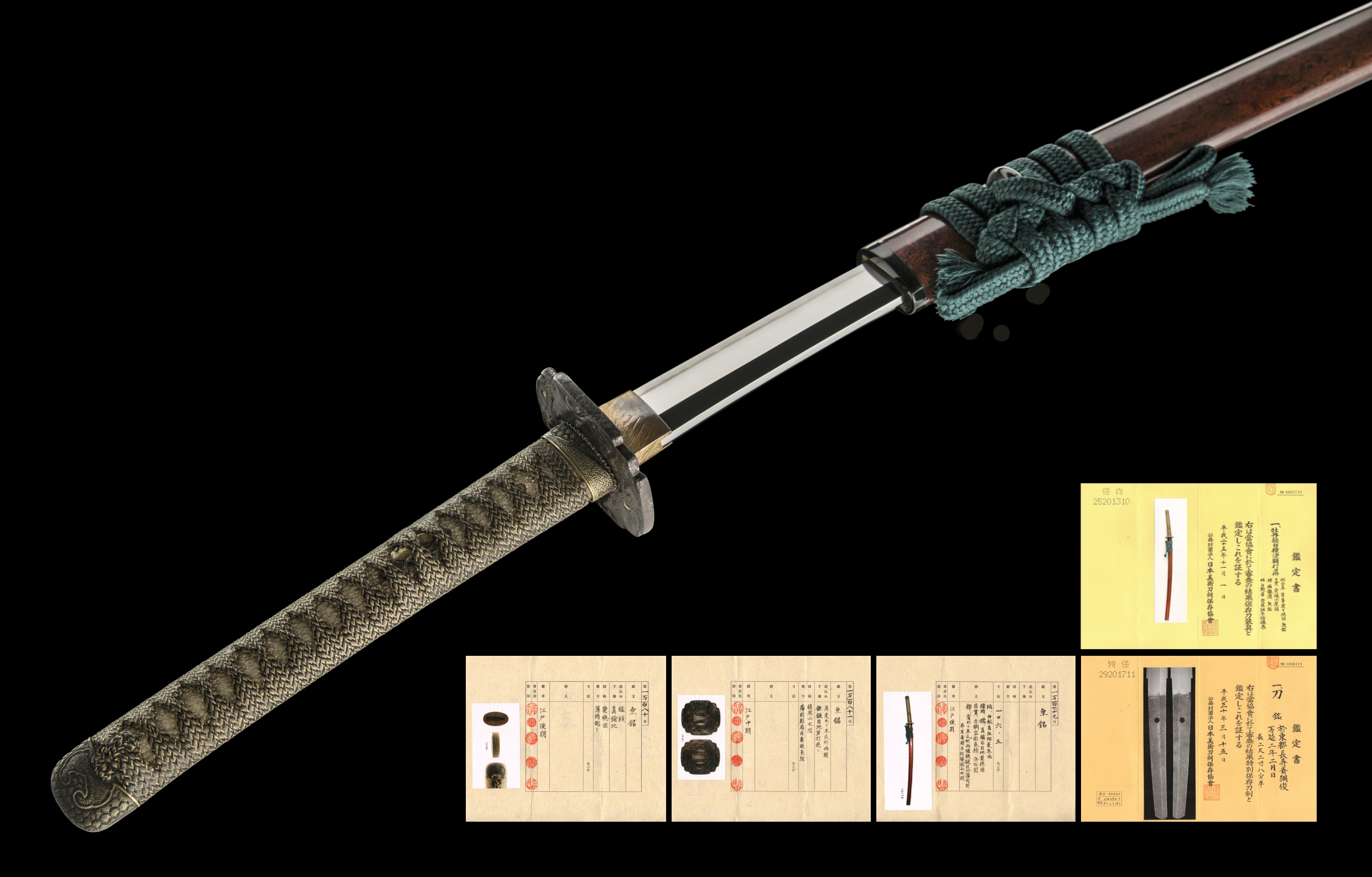
Born Kato Hachiro and trained under the shinshinto grandmaster Suishinshi Masahide – just as his father Kato Kunihide had been – Tsunatoshi represents the refined peak of the Edo revival tradition. He moved to the city during the Bunsei era (1818-1830) to work in the residence of the Uesugi family, the daimyo of Yonezawa, where he remained until his death on December 5th, 1863, in the 3rd year of Bunkyu, at the age of 66. In the first year of Ansei (1854) he passed his go (pen name) of Chunsai to his son Koretoshi and changed his own to Chojusai, meaning “old age.” This blade, dated in the second month of Man’en 2 (1861), is one of his final works.
The katana is wide and formidable, weighing close to one kilogram with a thick kasane (spine) that gives it serious presence. The jihada is a densely forged ko-itame with areas of Rai-style o-hada – exposed islands of mokume-hada that recall the ancient Rai school of Yamashiro from the Kamakura and Nambokucho periods – along with ji-nie, chikei, and light utsuri. Tanobe Michihiro’s sayagaki on the shirasaya notes this precisely: the blade bears an eight-character signature with a Man’en 2 date, is a late work of the first generation Tsunatoshi, and shows a gentle suguha that is rare for this smith. The hamon itself is a ko-midare based on suguha, with ko-ashi and yo, and the boshi resolves in a ko-maru (rounded turnback) with nie-kuzure crystals – a detail associated with the Yamashiro tradition that Tsunatoshi deliberately evoked.
The sword is accompanied by a handsome set of Edo koshirae lacquered in byakudan-nuri (a complex swirling technique reserved for objects of high status) with a peony pattern – the koshirae certified with NBTHK Hozon papers. The tsuba is a striking multi-lobed hammered iron piece from Yamashiro, depicting waves and castles in a landscape, attributed to the mid-Edo period (1700-1780) by the NTHK-NPO. The fuchi-kashira, depicting an awaho (foxtail millet) harvest, is attributed to the Sonobe school in Edo, Late Edo, and likewise NTHK-NPO certified.
| Item Number | UJKA338 |
| Sword Type | Katana |
| Swordsmith | Chôjusai Tsunatoshi (first generation) |
| Swordsmith (JP) | 長寿斎綱俊 |
| Signature | Toto ni oite Chôjusai Tsunatoshi |
| Date | Man’en 2 (1861), February |
| School | Suishinshi-ha (Shinshinto) |
| Province | Musashi (Edo/Tokyo) |
| Period | Shinshinto – Late Edo period (Man’en era: 1861) |
| Nagasa | 69.2 cm |
| Sori | 1.70 cm |
| Moto-haba | 3.26 cm |
| Weight | 950 g |
| Nakago | Ubu; kesho-yasurime (decorative file marks) |
| Jihada | Densely forged ko-itame with areas of o-hada (Rai-hada), ji-nie, chikei, light utsuri |
| Hamon | Ko-midare based on suguha with ko-ashi and yo |
| Boshi | Ko-maru with nie-kuzure |
| Certificates | NBTHK Tokubetsu Hozon; NBTHK Hozon (koshirae); NTHK-NPO Kanteisho x 3 (koshirae, tsuba, fuchi-kashira) |
| Fujishiro Rank | Jo-saku |
| Sayagaki | Tanobe Michihiro – Chôjusai Tsunatoshi, late work of the first generation, dated Heisei 29 (2017) |
| Koshirae | Botan shibori byakudan-nuri uchigatana-koshirae (peony pattern, byakudan lacquer), Late Edo (1780-1867); NBTHK Hozon |
| Tsuba | Multi-lobed hammered iron, waves and castle landscape, Yamashiro (Kyoto), Mid-Edo (1700-1780); NTHK-NPO Kanteisho |
| Fuchi-kashira | Awaho (foxtail millet) harvest design, attributed to Sonobe school, Edo, Late Edo (1780-1867); NTHK-NPO Kanteisho |
| Menuki | Feasting on trough shells (clams), gold, Late Edo |
| Habaki | Copper with diagonal file marks |
| Catalogue | Catalogue 34 |
| Status | Sold |
| Includes | Shirasaya (with sayagaki by Tanobe Michihiro), Edo koshirae, stand, bag, kit, DVD, printed description |