
ITEM# UJKA186 – Catalogue 25 – Sold
A Nidai Yasutsugu Katana (康継作無銘・三代康継銘之)
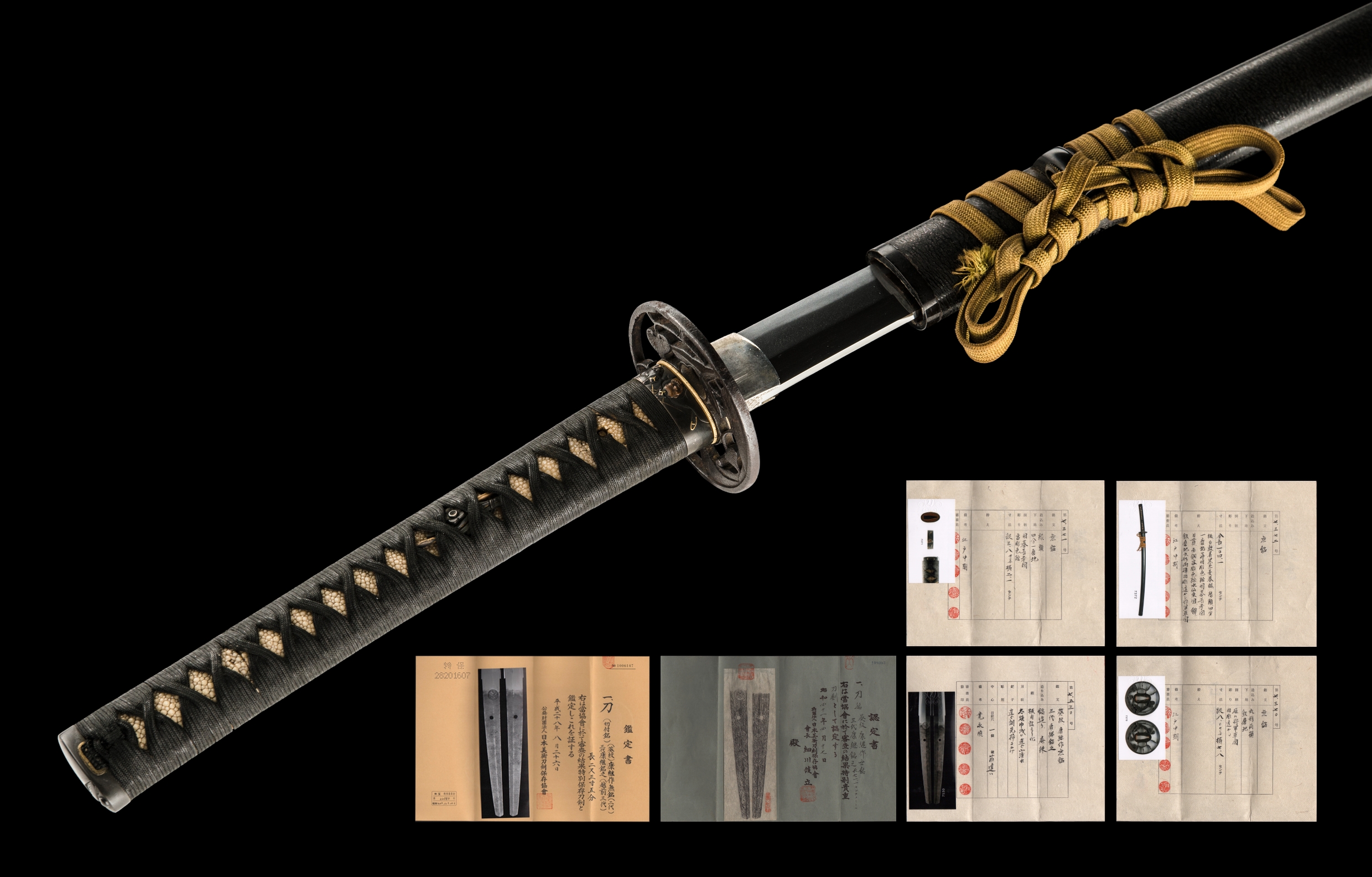
The Yasutsugu school occupies a singular position in Japanese sword history. From the first generation’s patronage by Tokugawa Ieyasu himself – granted the right to carve the hollyhock aoi-mon on every blade – to the eventual split into Edo and Echizen branches, the lineage produced some of the most technically accomplished blades of the early Shintô period. This katana was forged by the second generation, working in Edo during the height of the Kan’ei era. He died in 1646, and this blade was left unsigned – possibly because he was too ill to complete it, or simply out of protocol. His younger brother, the third generation Echizen Yasutsugu, later signed the nakago on the reverse to confirm its authorship.
The blade itself is exactly what collectors expect from the Nidai: a deeply worked itame jihada alive with chikei – those dark, shifting streaks of crystallised nie that give the steel its inner fire. The hamon is a refined ko-notare, the small undulating waves accented by sunagashi (brushed-sand activity) and kinsuji (golden lines running through the temper). The nioguchi is characteristic of the Nidai – thick and bright, a hallmark of the school at its best. At 71.2cm it handles with authority, and the ubu (original length) nakago confirms its integrity.
The accompanying Edo-period koshirae is a complete set of considerable quality, certified by the NTHK-NPO. The iron sukashi tsuba from the Shoami School depicts the Yasutsugu family’s own aoi-mon alongside three geese in flight – an intentional pairing with the blade it guards. The fuchi-kashira show two daimyô lords absorbed in a game of GO, with a spider’s web inlaid in gold on the kashira. The saya is lacquered in aoi-gai mother-of-pearl, and the kojiri is magnificently carved with a dragon in high relief. The tsuka has survived intact from the mid-Edo period. Five certificates of authenticity accompany this sword.
| Item Number | UJKA186 |
| Sword Type | Katana |
| Attribution | Attributed to Nidai (2nd generation) Yasutsugu (mumei) |
| Signature | Omote: Aoi mon, Yasutsugu Saku Mumei / Ura: San-Dai Yasutsugu Mei Kore (signed by 3rd generation Echizen Yasutsugu) |
| School | Yasutsugu |
| Province | Edo (modern-day Tokyo) |
| Period | Shintô – Early Edo period (Kan’ei era: 1624-1645) |
| Nagasa | 71.2cm |
| Sori | 1.1cm |
| Moto-haba | 3.0cm |
| Weight | 670g |
| Nakago | Ubu (original length), 21.8cm |
| Jihada | Itame with ji-nie and chikei |
| Hamon | Ko-notare with kinsuji, sunagashi and ashi, wide yaki |
| Certificates | NBTHK Tokubetsu Kicho (sword); NTHK-NPO Kanteisho (sword, tsuba, fuchi-kashira and koshirae) |
| Fujishiro Rank | Jo-saku |
| Sharpness Rating | Ryo-Wazamono (Asaemon) |
| Koshirae | Edo-period koshirae (mid-Edo, 1700s), certified NTHK-NPO Kanteisho |
| Tsuba | Polished iron sukashi tsuba, Shoami School, mid-Edo period (1700s). Depicts aoi-mon and three geese in flight. NTHK-NPO Kanteisho certified. |
| Fuchi-kashira | Two daimyo lords playing GO; kashira with gold-inlaid spider web design. NTHK-NPO Kanteisho certified. |
| Tsuka | Original mid-Edo period (1700s), black ito over same |
| Habaki | Gin-habaki (silver) |
| Catalogue | Catalogue 25 |
| Status | Sold |
| Includes | Edo-period koshirae, shirasaya, carry bags, sword stand, maintenance kit |