
ITEM# UJKA188 – Catalogue 25 – Sold
A Yakuwa Yasutake Katana (武蔵国住八鍬靖武作之)
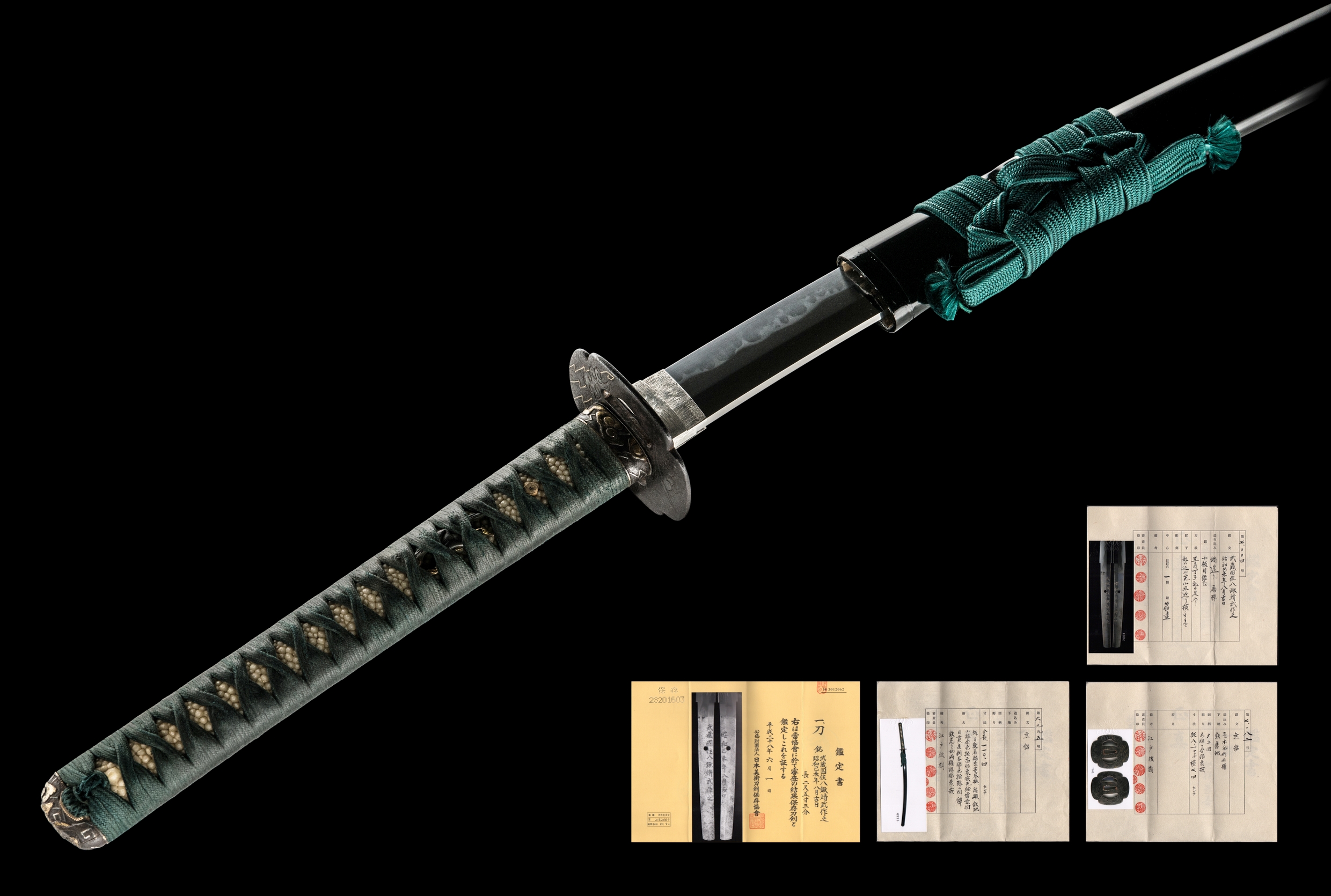
To understand Yakuwa Yasutake is to understand the Nihonto Tanren Kai (NTK) – the remarkable forge established in 1933 on the grounds of Yasukuni Shrine in Tokyo, where some thirty swordsmiths produced over 8,000 blades for high-ranking military officers during Japan’s wartime years. The NTK was no ordinary wartime operation: they constructed their own tatara smelter to produce tamahagane in the traditional manner, and the quality of their output reflected it. Yasutake joined the NTK as a handyman in 1935 and was recognised as a fully established Yasukuni smith by 1944. After the war he resumed forging in 1954 and went on to become widely regarded as the finest of all the postwar Yasukuni smiths – a distinction confirmed in 1981 when he received mukanza, the highest honour awarded to a Japanese swordsmith, meaning his work was submitted without judgement. He died in 1984, and this katana, completed in August 1979, stands at the very summit of his career.
The blade is crafted firmly in the Bizen tradition, with a long, elegant form and a superb gunome choji midare – a temper line of wild clove blossoms that rolls with energy along the entire length. The steel shows clear midare utsuri, the shadowy reflection of the hamon in the body of the blade that is one of the most admired qualities in Bizen-tradition work and one of the hardest to achieve. The sword is well-polished and in excellent condition throughout.
An Edo-period Higo koshirae accompanies the blade, centred on a magnificent Jingo school iron tsuba with gold and silver inlay depicting bolts of lightning amid a thunderstorm – crafted in the late Edo period, mid-1800s. The fuchi-kashira carry the same spirit, and the green-cord tsuka is fitted with bronze crane (tsuru) menuki – the crane being a symbol of longevity and good fortune in Japanese tradition. Four certificates accompany this piece: NBTHK Hozon for the blade, and NTHK-NPO Kanteisho for the sword, tsuba and koshirae respectively.
| Item Number | UJKA188 |
| Sword Type | Katana |
| Swordsmith | Yakuwa Yasutake |
| Swordsmith (JP) | 武蔵国住八鍬靖武 |
| Signature | Musashi no Kuni ju Yakuwa Yasutake saku kore |
| Date | Shôwa 54, 8th month, auspicious day (August 1979, year of the sheep) |
| Province | Musashi (Tokyo) |
| Period | Shôwa (1979) |
| Nagasa | 76.6cm |
| Sori | 2.2cm |
| Moto-haba | 3.2cm |
| Saki-haba | 2.3cm |
| Moto-kasane | 7.3mm |
| Saki-kasane | 5.4mm |
| Nakago | 22cm, ubu (original length), 1 mekugi-ana |
| Weight | 890g |
| Jihada | Tight itame-hada with midare utsuri |
| Hamon | Gunome choji midare with long ashi |
| Habaki | Niju yokoyasuri-habaki (silver, double) |
| Koshirae | Edo-period Higo koshirae |
| Tsuba | Jingo school, polished iron with gold and silver inlay; lightning amid thunderstorm; late Edo period, mid-1800s; NTHK-NPO Kanteisho |
| Fuchi-kashira | Higo school, shakudo with thunderstorm theme |
| Menuki | Tsuru (crane), bronze |
| Tsuka | Green silk braid over same |
| Certificates | NBTHK Hozon (blade); NTHK-NPO Kanteisho (sword, tsuba, koshirae) |
| Catalogue | Catalogue 25 |
| Status | Sold |
| Includes | Edo-period Higo koshirae, shirasaya, silk carry bag, stand, maintenance kit, DVD, printed care guide, all exportation paperwork from Japan |