
ITEM# UJKA428 – Catalogue 40 – Sold
A Nidai Kanemichi Katana (丹後守兼道)
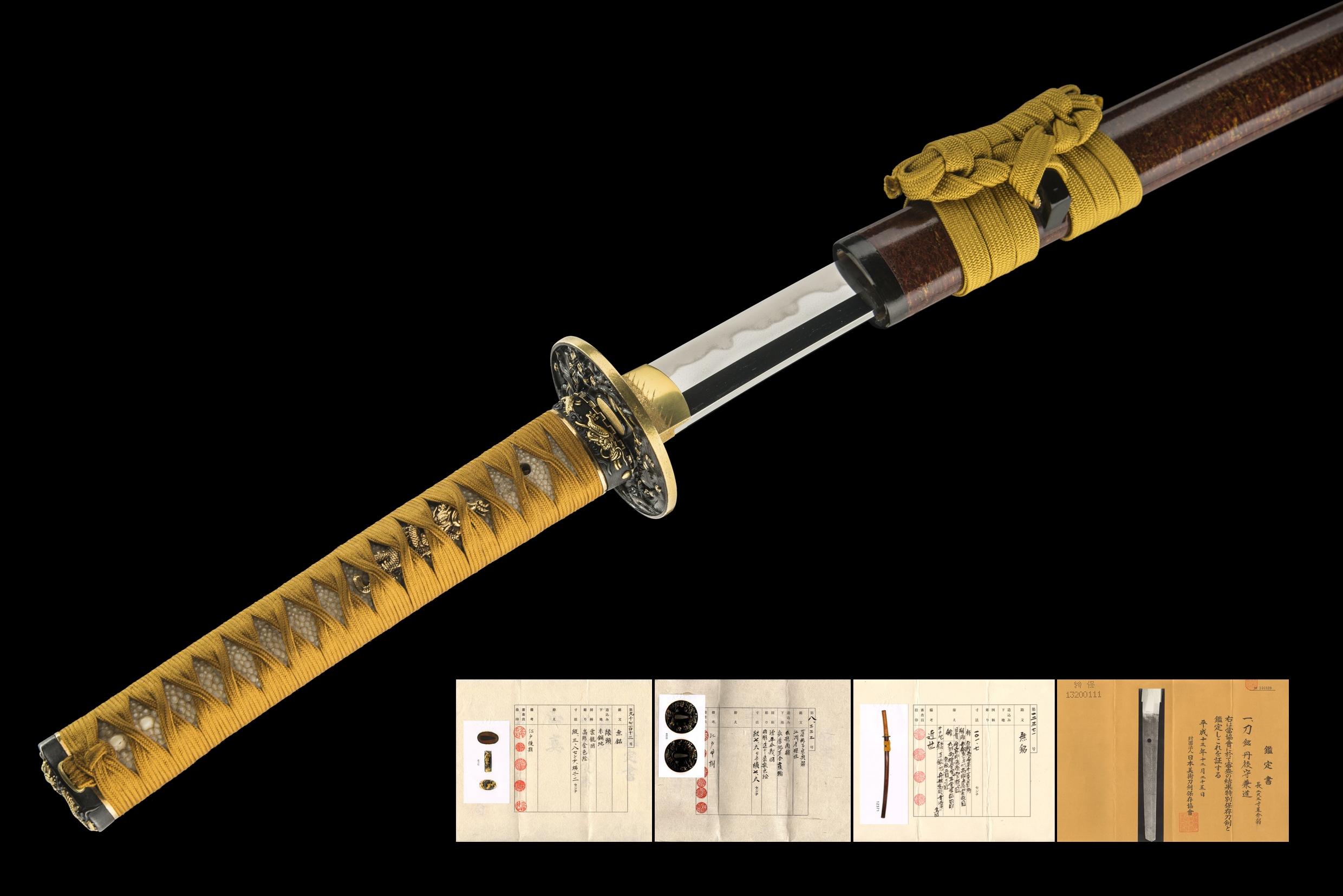
Nidai Kanemichi was born Mishina Kaheji, son of shodai (first generation) Kanemichi, who also signed Naomichi. He flourished during the Genroku era in Settsu province (Ôsaka), though he also worked in Edo – modern day Tôkyô. Like his famous Mishina ancestor Tanba no Kami Yoshimichi, he chiselled the distinctive sail-inspired Tan 丹 character at the top of his title – the hallmark of the Ôsaka-Tanba branch, identified by the stroke pointing south rather than the Kyô-Tanba branch’s north-west orientation.
This superb jô-sun (2-shaku 3-sun 5-bu) katana is a feast for the senses. The rhythmic gunome-midare hamon marches along the blade in characteristic bunches of two and three, the snow-capped yakigashira blanketed in deep nioi-deki with a definite stream of nie crystals running beneath. The steel is tightly forged ko-itame-hada, healthy and crisp throughout. The ubu nakago retains beautifully aged patina with clean sujikai-yasurime and one mekugi-ana. NBTHK awarded this blade Tokubetsu Hozon on Christmas Day 2001 – a fitting date for such a gift-worthy sword.
The Tsugaru-nuri koshirae is a spectacle in its own right. The saya, lacquered in the celebrated technique originating from wintery Aomori, displays a gorgeous kincha-nuri finish that rewards close inspection. Awesome cloud dragons – unryû – guard the fuchi-kashira in shakudô with nanako ground and gold accents, attributed to Yokoya Eisei of the Yanagawa school. The striking shakudô tsuba from the Mogarashi school depicts China’s Three Kingdoms period, with Liu Bei riding above a surging dragon amidst waves and torii, the spare holes filled with gold by a previous owner of considerable means. Extra-large dragon menuki complete a koshirae of exceptional coherence and quality.
| Item Number | UJKA428 |
| Sword Type | Katana |
| Swordsmith | Tango no Kami Kanemichi (2nd gen.) |
| Swordsmith (JP) | 丹後守兼道(二代) |
| Signature | Tango no Kami Kanemichi |
| School | Mishina (Ôsaka-Tanba branch) |
| Province | Settsu |
| Period | Shintô – Early Edo period (Genroku era: 1688-1704) |
| Nagasa | 71.4cm (2-shaku 3-sun 5-bu) |
| Sori | 1.36cm |
| Moto-haba | 3.02cm |
| Weight | 705g |
| Nakago | Ubu, sujikai-yasurime, one mekugi-ana, 21.4cm |
| Jihada | Tightly forged ko-itame-hada |
| Hamon | Rhythmic gunome-midare with deep nioi and nie, yakigashira in nioi-deki |
| Boshi | Ko-maru |
| Certificates | NBTHK Tokubetsu Hozon (issued Heisei 13 / 2001, December 25); NTHK-NPO Kanteishô (sword, koshirae, fuchi-kashira and tsuba certified as Authentic) |
| Fujishiro Rank | Chûjô-saku |
| Sharpness Rating | Wazamono |
| Koshirae | Kincha-Tsugaru-nuri uchigatana-koshirae (金茶津軽塗鞘打刀拵え), Late Edo period |
| Tsuba | Shakudô, polished, depicting China’s Three Kingdoms – Liu Bei on horseback above a dragon amid waves and torii; gold-filled kozuka and kôgai holes; gold rim. Mogarashi school, Late Edo period. NTHK-NPO Kanteishô certified. |
| Fuchi-kashira | Shakudô with nanako ground; unryû (cloud dragon) in gold relief. Attributed to Yokoya Eisei, Yanagawa school, Late Edo period. NTHK-NPO Kanteishô certified. |
| Menuki | Extra-large dragon menuki in gold on samekawa, secured by gold-braided silk |
| Tsuka | Samekawa (ray skin) with gold-braided silk, Late Edo period |
| Habaki | Gold yûjô-habaki |
| Catalogue | Catalogue 40 |
| Status | Sold |
| Includes | Shirasaya, Tsugaru-nuri koshirae, fabric bags, stand, kit, printed description |