
ITEM# UJKA431 – Catalogue 41 – Sold
A Yondai Tadayoshi Tameshigiri Katana (肥前国近江大掾藤原忠吉)
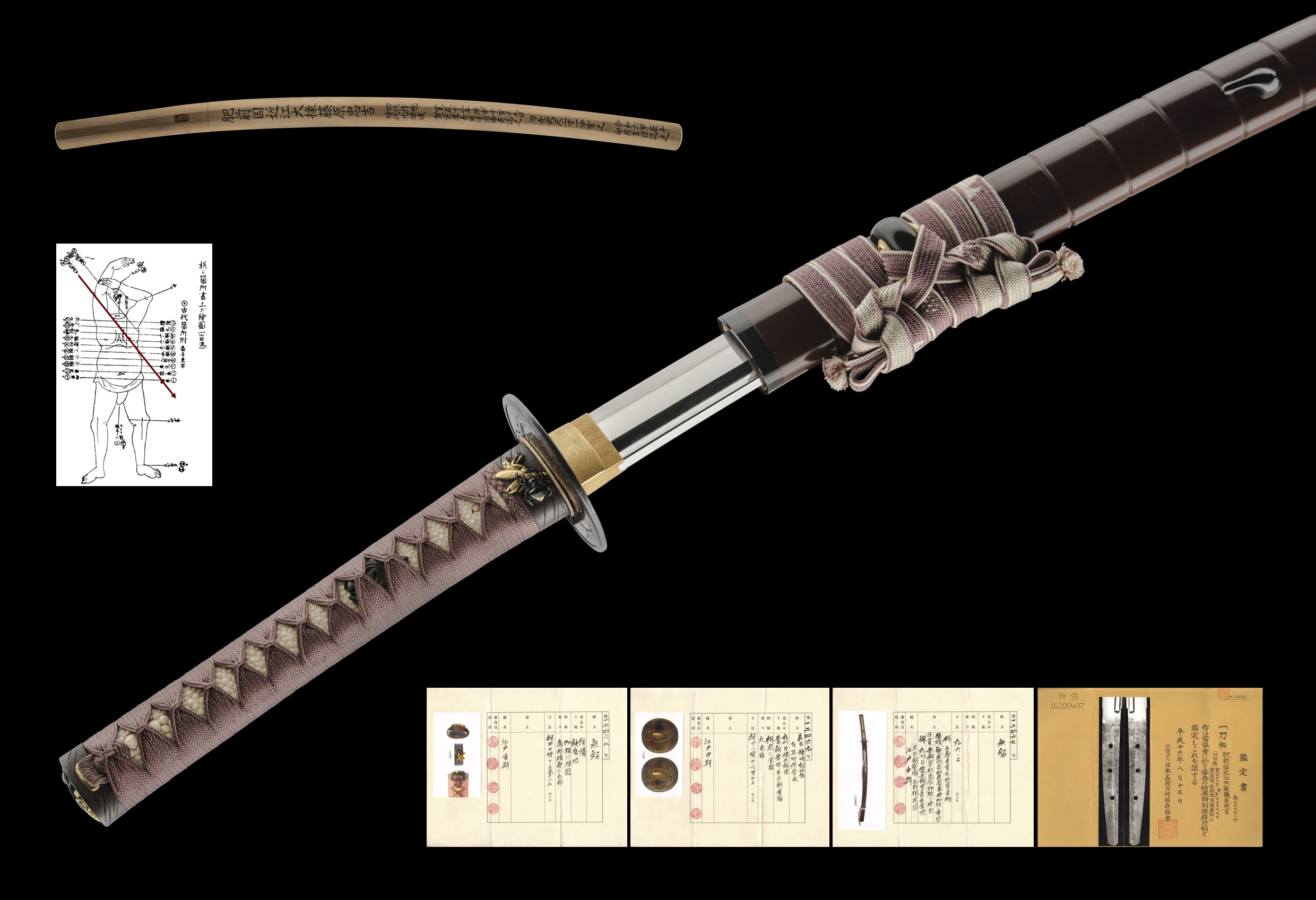
Yondai (fourth generation) Tadayoshi was born Hashimoto Gensuke and later known as Shinzaburô. He was the eldest son of the gifted sandai (third generation) Tadayoshi and inherited the most prestigious smithing lineage in Hizen province. Receiving the honorary title of Ômi no Daijô on March 10, 1700, he went on to train under his grandfather nidai (second generation) Tadahiro following his father’s untimely death, and also produced daisaku swords in his master’s name. He died on September 9, 1747 at the age of eighty – a career spanning more than four decades at the highest level. Fujishiro ranks him Jô-saku, a superior swordsmith.
This is a blade with a documented history of violence. On December 19, 1800 – nearly a century after the sword was forged – it was taken up by Nagasaka Miki Katsuhide, a retainer of the Aizu clan under the Tokugawa Shogunate, and tested in a kesa-otoshi tameshigiri: a single diagonal cut from the base of the shoulder through to the opposite armpit. The target may have been alive at the time of the cut. The inscription recording this event is chiselled into the reverse of the nakago with total precision. Historical records from Aizu Wakamatsu city confirm that Katsuhide was born in the Kanpô era (1741), taught at a sword combat school, was proficient with firearms, and lived at least until the second year of Bunsei (1819). The blade itself has been carefully shortened by approximately one shaku (~3cm) at some point – almost certainly to suit a previous owner of smaller stature.
The steel is vibrant and characterful. Unlike the typically tight konuka-hada seen on many Hizen blades, this one shows a more expressive mix of itame and mokume-hada with abundant chikei threading through the ji. The ko-gunome midare hamon runs the full length of the blade with a remarkable density of ashi – like rows of razor-sharp teeth – and occasional yo (detached activity) visible in the upper sections. The middle Edo-period kizami (sectioned) koshirae is exceptional: a dark brown lacquered saya notched every 3cm, a pink-braided tsuka in jabara-maki, and a show-stopping fuchi-kashira and menuki set from the Tetsugendô school depicting a black spider consuming a gold hornet. The tsuba is a weighty copper piece bearing the kiri (paulownia) crest – the seal of the office of prime minister and the government of Japan – signed by Kanenaga of the Shôami school from Iyo province. This is, in every sense, a samurai sword.
| Item Number | UJKA431 |
| Sword Type | Katana |
| Swordsmith | Yondai (4th generation) Ômi Daijô Fujiwara Tadayoshi |
| Swordsmith (JP) | 肥前国近江大掾藤原忠吉(四代) |
| Signature | Hizen no Kuni Ômi Daijô Fujiwara Tadayoshi |
| School | Tadayoshi school |
| Province | Hizen |
| Period | Early Edo – Genroku era (1700~1704) |
| Nagasa | 66.7cm (ubu, machi-okuri) |
| Sori | 1.8cm |
| Moto-haba | 3.2cm |
| Weight | 780g |
| Nakago | Machi-okuri (shortened blade length), kiri-yasurime (straight file marks), 1 active mekugi-ana (2 additional holes filled by a previous owner) |
| Jihada | Vibrant mix of itame-hada and mokume-hada with ji-nie and plentiful chikei |
| Hamon | Ko-gunome midare with many ko-ashi |
| Certificates | NBTHK Tokubetsu Hozon; NTHK-NPO Kanteishô (koshirae, fuchi-kashira and tsuba certified as Authentic) |
| Fujishiro Rank | Jô-saku (ranked as a superior swordsmith) |
| Sayagaki | Nozomi-san (shodô artist) – inscribed in the 4th month, Reiwa 6 (April 2024) |
| Tameshigiri (JP) | (切付銘) 寛政十二年庚申十二月十九日 袈裟落長坂造酒勝英試之 |
| Koshirae | Cha-urushi-nuri issun-kizami saya uchigatana-koshirae (茶漆塗一寸刻鞘打刀拵) – brown lacquered saya notched every 3cm, Middle Edo period (1700~1780) |
| Tsuba | Copper, kiri (paulownia) design, signed Kanenaga – Shôami school, Iyo province (Matsuyama / present-day Ehime); rim reinforced with fukurin; one hitsu-ana filled with shakudô. NTHK-NPO Kanteishô certified. |
| Fuchi-kashira | Attributed to Tetsugendô school, Late Edo period – iron, spider devouring a hornet in gold and shakudô. NTHK-NPO Kanteishô certified. |
| Menuki | Spider and hornet motif, matching the fuchi-kashira theme |
| Tsuka | Jabara-maki braid in pink/mauve silk over stingray same |
| Habaki | Gold niju habaki with kiri file marks |
| Catalogue | Catalogue 41 |
| Status | Sold |
| Includes | Shirasaya with sayagaki, Edo koshirae with koshirae bag, fabric bags, stand, maintenance kit, printed description, original torokushô (registration card, Showa 26 / 1951, serial #3669) |