
ITEM# UJDI013 – Catalogue 43 – Sold
A Tadayoshi/Tadahiro Daishô (肥前国住人忠吉(四代)/肥前国住藤原忠広(二代))
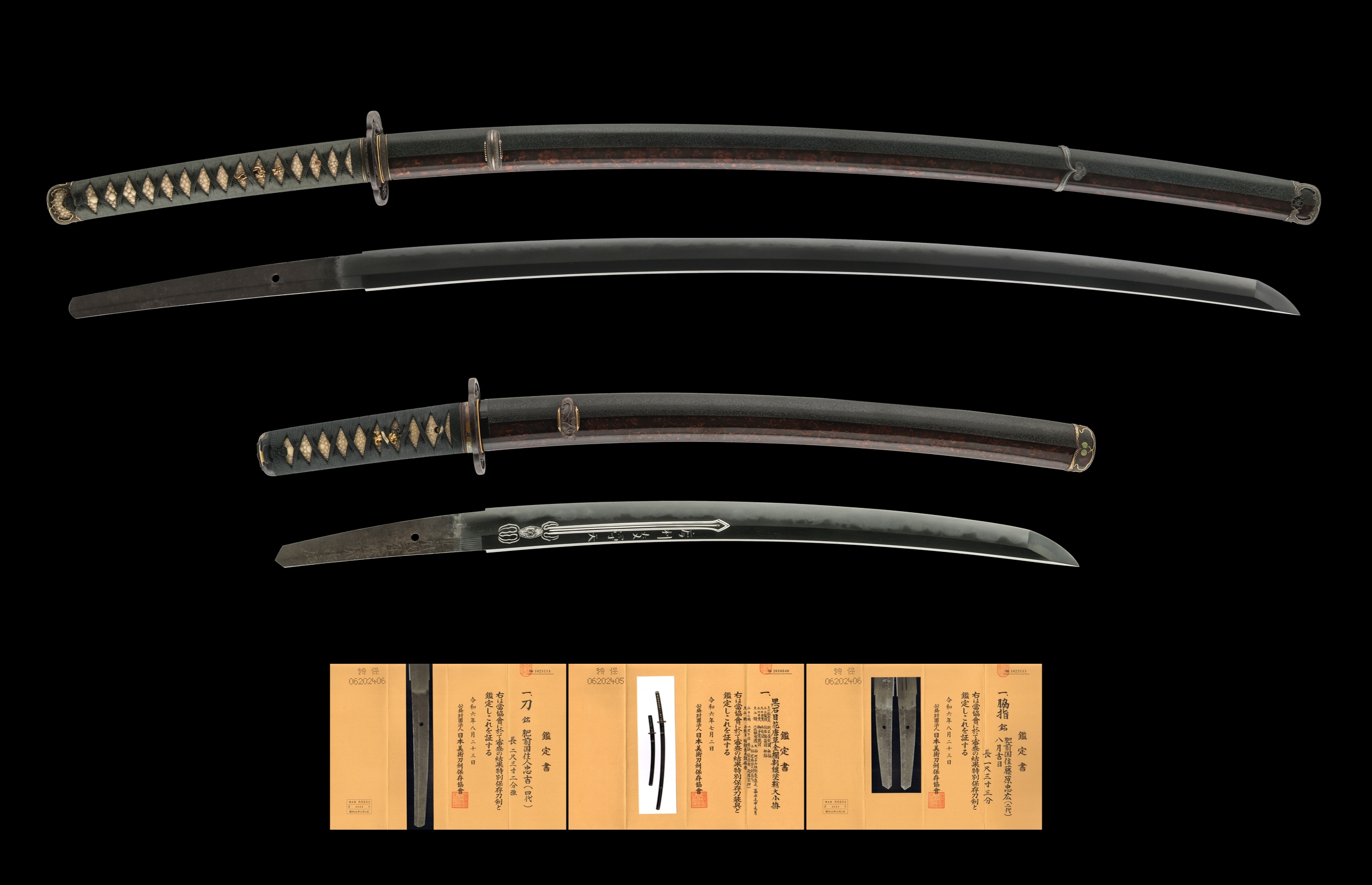
This exceptional daishô pairs a katana by fourth generation Tadayoshi with a wakizashi by second generation Tadahiro – both masters of the renowned Tadayoshi school of Hizen province in Kyûshû. The fourth generation, born Hashimoto Gensuke and later known as Shinzaburô, was the oldest son of sandai (third generation) Tadayoshi. He trained under his grandfather, nidai Tadahiro, and was awarded the honorary title of Ômi no Daijô in 1700. The second generation Tadahiro, born Hashimoto Heishiro in 1614, took over leadership of the Tadayoshi school at just nineteen upon his father’s death and was granted the title of Omi Daijô in 1641 at the age of twenty-eight.
The blades display graceful curvature adorned with a spectacular gunome-chôji-midare hamon rich in kinsuji, sunagashi, and ashi, all in nie-deki. The jihada is a vibrant mix of itame and konuka-hada with ji-nie and plentiful chikei – hallmarks of the finest Hizen-tô. The wakizashi carries exceptional horimono: a sankozuka-ken (trident-shaped sword) flanked by the name Marishisonten on one side, and a bonji symbolising Gundari Myôô with gomabashi grooves on the other – deeply spiritual imagery evoking divine protection.
The matched daishô-koshirae – a kuro-ishime hana-karakusa kinran waritsugi-nuri saya set – features scabbards with a split-lacquer design combining black stone-surface lacquer and gold brocade with a floral and arabesque pattern, dated to the late Edo to very early Meiji period (circa 1867–1870). The tsubas are an extraordinary matched pair by premier Owari metalsmith Iwata Norisuke (岩田則亮), depicting life-like tombo (dragonflies) in iron. The fuchi-kashira on the katana bears the ken-hanabishi crest honouring the Nabeshima lords who ruled the Saga domain of Hizen province. The wakizashi‘s kashira showcases a musubi-bukuro motif with gold flower crests and a stylised amaryû (rain dragon), while the fuchi is embellished with shippô cloisonné enamel. All three NBTHK Tokubetsu Hozon certifications – for both blades and the daishô-koshirae – are a testament to the outstanding quality of this ensemble. These swords were among the very first registered in Japan, bearing sequential torokusho numbers 4044 and 4045, issued on October 5, 1951.
| Item Number | UJDI013 |
| Sword Type | Daishô (katana & wakizashi) |
| Swordsmith (katana) | Yondai Tadayoshi |
| Swordsmith (JP) (katana) | 肥前国住人忠吉(四代) |
| Swordsmith (wakizashi) | Nidai Tadahiro |
| Swordsmith (JP) (wakizashi) | 肥前国住藤原忠広(二代) |
| Signature (katana) | Hizen no Kuni jûnin Tadayoshi (Yondai) |
| Signature (wakizashi) | Hizen no Kuni jû Fujiwara Tadahiro (Nidai) / Hachigatsu kichijitsu |
| School | Tadayoshi school |
| Province | Hizen |
| Period | Shintô – Genroku era (katana, 1688-1704) & Keian era (wakizashi, 1648-1652) |
| Nagasa (katana) | 70.4cm |
| Nagasa (wakizashi) | 40.3cm |
| Sori (katana) | 2.1cm |
| Sori (wakizashi) | 1.2cm |
| Moto-haba (katana) | 2.93cm |
| Moto-haba (wakizashi) | 2.9cm |
| Weight (katana) | 740g |
| Weight (wakizashi) | 405g |
| Nakago (katana) | Ubu, kiri-yasurime, kuirijiri, one mekugi-ana (22.0cm) |
| Nakago (wakizashi) | Ubu, kiri-yasurime, kengyô, one mekugi-ana (14.1cm) |
| Jihada | Vibrant mix of itame-hada and konuka-hada with ji-nie and plentiful chikei |
| Hamon | Spectacular gunome-chôji-midare with kinsuji, sunagashi, ashi in nie-deki |
| Boshi (katana) | Komaru-kaeri with tsukiage, nie-deki |
| Boshi (wakizashi) | Hakikake, nie-deki |
| Certificates | 3 x NBTHK Tokubetsu Hozon (katana, wakizashi, and daishô-koshirae) |
| Fujishiro Rank | Jôjo-saku (nidai Tadahiro) & Jô-saku (yondai Tadayoshi) |
| Sharpness Rating | O-Wazamono (nidai Tadahiro is a maker of extremely sharp swords) |
| Sayagaki | Nozomi-san (shodô artist) – inscribed in the first month, Reiwa 7 (January 2025) |
| Koshirae | Kuro-ishime hana-karakusa kinran waritsugi-nuri saya daishô-koshirae (黒石目花唐草金襴割継塗鞘大小拵) – late Edo to very early Meiji, circa 1867-1870. NBTHK Tokubetsu Hozon certified. |
| Tsuba | Matched daishô pair, iron tombo (dragonfly) design by Iwata Norisuke (岩田則亮), Owari province. Katana tsuba dated Kaei no saru kugatsu (September 1848). |
| Fuchi-kashira (katana) | Ken-hanabishi (sword and flower) motif honouring the Nabeshima family, lords of Saga domain, Hizen province |
| Fuchi-kashira (wakizashi) | Musubi-bukuro with gold flower crests and stylised amaryû (rain dragon); fuchi with shippô (cloisonné enamel) |
| Menuki (katana) | Amaryû (rain dragons) in gilt metal |
| Menuki (wakizashi) | Shishi (sacred lions) in gilt metal |
| Habaki (katana) | Gold nijû-habaki with botan-yasuri (peony) file marks |
| Habaki (wakizashi) | Gold nijû-habaki with diamond-shaped pattern |
| Catalogue | Catalogue 43 |
| Status | Sold |
| Includes | Shirasaya (both), daishô-koshirae, fabric bags, stand, kit, printed description |